Earth and Environmental Sciences, B.S.
School of Natural and Behavioral Sciences
Program Overview
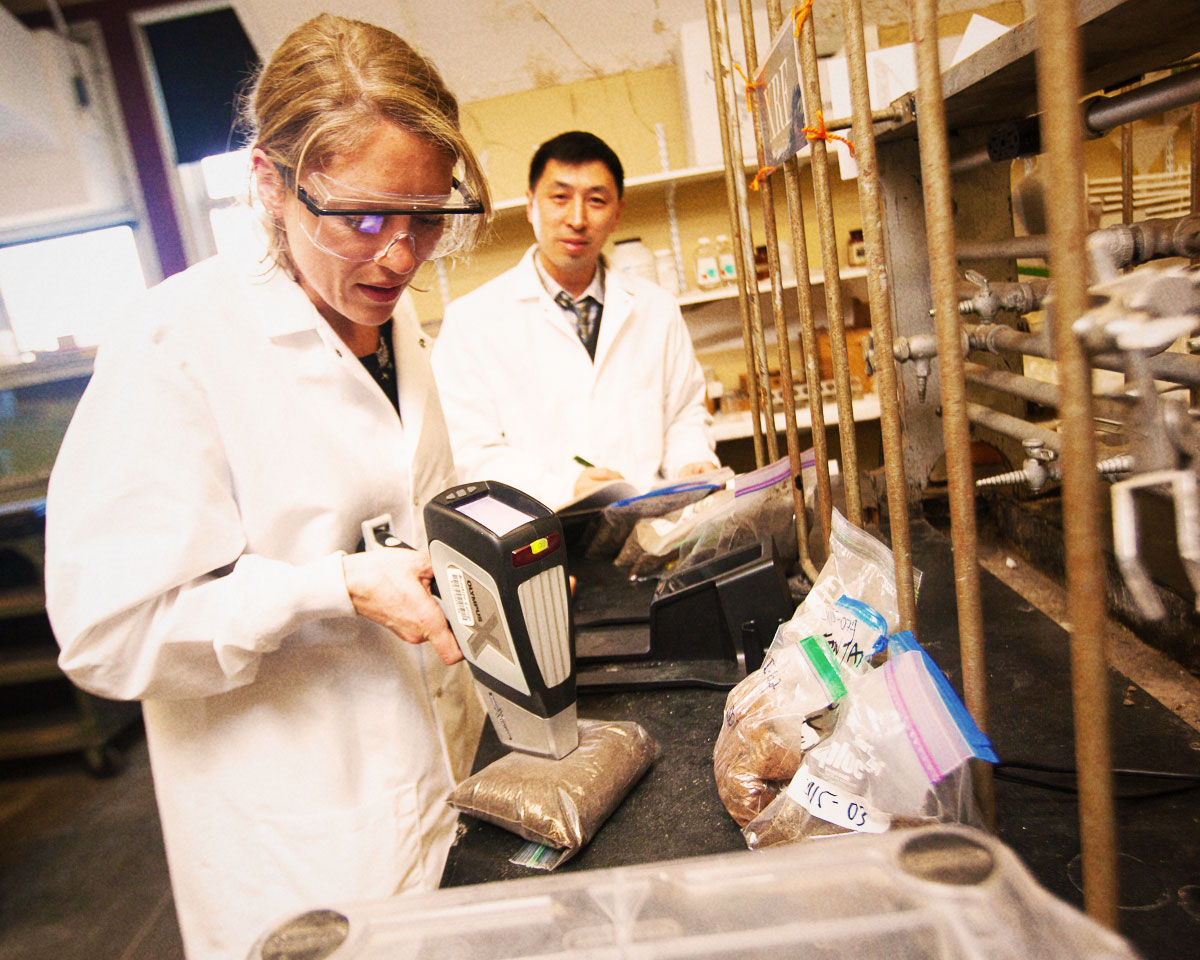
In this major, you’ll explore Earth’s dynamic processes, find fossils and minerals, test waters and analyze soils, examine rock outcrops to understand Earth’s history, and learn how the environment affects humans and how, in turn, humans impact our environment. Our faculty members have experience and skills across the full spectrum of the earth and environmental sciences to help you navigate the rocks, soils, landscapes, coastlines, and waters of New York City and beyond. In the Bachelor of Science degree program, you’ll be required to take more advanced courses than in the Bachelor of Arts degree program.
Major Details
The program information listed here reflects the approved curriculum for the 2026–27 academic year per the Brooklyn College Bulletin. Bulletins from past academic years can be found here.
Major Requirements (64.5–66 Credits)
NYSED Program Code: 02092
All of the following:
- Earth and Environmental Sciences 1101, 1201, 2100, 2200W, 2400, or 7521G, 2500 or 7911G, 3100, 3600, 3975 or 7335G.
- At least 18 elective credits in the following courses: any Earth and Environmental Sciences courses numbered 4000 or above, and which may include up to six credits in courses from the following departments after permission of the EESC chair: Anthropology, Biology, Chemistry, Health and Nutrition Sciences, and Physics.
- One of the following capstone courses: Earth and Environmental Sciences 4010 or 4250.
- Chemistry 1040, 1100 or its equivalent.
- Mathematics 1201.
- Mathematics 1206 or Computer and Information Science 1115 or Earth and Environmental Sciences 2600 or 7771G.
- Biology 1001 or Physics 1100 or its equivalent or Physics 1150.
All required earth and environmental sciences courses numbered 2000 or higher must be completed with a grade of C- or higher in each course. A college-wide minimum of 24 credits in advanced courses in Earth and Environmental Science must be completed at Brooklyn College.
Additional Requirements
Candidates for a B.S. degree with a major in earth and environmental sciences must complete at least 60 credits in science and mathematics; 24 of these 60 credits must be completed in advanced courses in the Earth and Environmental Sciences Department. These 24 credits must be completed at Brooklyn College with a grade of C- or higher in each course. Specific course requirements for a B.S. degree are described above.
The following courses may be applied toward the 60 credits in science and mathematics:
- All courses in the departments of Biology, Chemistry, Computer and Information Science, Earth and Environmental Sciences, Mathematics, Physics, and Psychology.
- Courses marked with a number sign (#) in the Department of Health and Nutrition Sciences.
- Anthropology 2200, 3199, 3230, 3240, 3250, 3260, 3265, 3266, 3425, 3440, 3470, 4665.
- Core Curriculum [1300 through 1399] and 3301 through 3399.
- Economics 3400, 4410, 3410, 4422.
- Philosophy 3203, 3204, 3231, 3232, 3422, 3423, 3601, 3605, 3610.
- Kinesiology 3271, 3275, 3281, 3285, 4229, 4251.
- Sociology 2701.
Accelerated Master’s
Any of the courses EESC 7521G, 7911G, 7335G, 7680G, 7690G, 7522G, 7600G, 7730G, 7500G, 7515G, 7913G, 7151G, 7914G, 7429G, 7214G and 7771G, taken as part of the EES undergraduate major, up to 12 credits may count for both the student’s undergraduate degree and the subsequent graduate degree at Brooklyn College.
For students intending to join the Earth and Environmental Science M.S. or M.A. programs, with department approval they may take 7680G or 7690G (in lieu of 4325), 7522G (in lieu of 4750), 7600G or 7730G (in lieu of 4335), 7500G or 7515G (in lieu of 4310), 7913G (in lieu of 4175), 7151G (in lieu of 4650), 7914G (in lieu of 4300), 7429G (in lieu of 4060), or 7214G (in lieu of 4150) to satisfy the elective credit requirements.
Graduate classes are intended for students intending to join the Earth and Environmental Science M.S. or M.A. programs and require departmental approval.
Student Learning Outcomes
Graduates of the program will be able to:
- describe how processes operating at and beneath the Earth’s surface create the Earth’s landscape and materials;
- describe how processes operating at and beneath the Earth’s surface affect, and are effected by, human activities;
- provide example as to how physics, chemistry, biology, and mathematics are applied to the study of Earth;
- conceptualize the Earth and environment as a set of connected systems;
- analyze and interpret 3D features/structures; and
- communicate effectively to a variety of audiences in a variety of formats.
Degree Maps
To help you pursue your studies in the most efficient manner, and to maximize your efforts to graduate in four years, Brooklyn College has created four-year degree maps for all its majors.
View degree maps for this major and others.
The Support You’ll Find
Brooklyn College is an integral part of the cultural and artistic energy of New York City. Our faculty members in the Department of Earth and Environmental Sciences offer incomparable expertise and tremendous talent, and each brings a unique perspective to their teaching and mentoring in and out of the classroom.


Internships and Employers
Through job fairs, the internship database, and internship panels, the Magner Career Center gives students in the earth and environmental sciences B.S. program access to career opportunities at a wide variety of employers, including:
- American Red Cross
- Athenica Environmental Services
- CivicPlus
- Gateway National Recreation Area
- LifeSci NYC
- Memory and Cognition Lab
- Mount Sinai Hospital
- National Parks Conservation Association
- New York City Department of Education
- New York City Department of Environmental Protection
- New York City Department of Health and Mental Hygiene
- New York Methodist Hospital
- North American Youth Parliament for Water
- Prospect Park Zoo
- SUNY Downstate Medical Center
- The Surfrider Foundation
- UnifyImpact
- Wildlife Conservation Society