Urban Sustainability, B.A.
School of Humanities and Social Sciences
Program Overview
The Urban Sustainability Program provides you with the knowledge and skills to promote sustainable policies and practices in New York City and beyond. The program explores the dynamics between social and natural systems, as well as the trade-offs among environmental, social, and economic sustainability. Brooklyn College’s urban setting provides you with the opportunity to observe firsthand the issues affecting our cities and to devise solutions that foster environmental protection, social equity, and economic vitality.
Major Details
The program information listed here reflects the approved curriculum for the 2025–26 academic year per the Brooklyn College Bulletin. Bulletins from past academic years can be found here.
Major Description
NYSED Program Code: 21627
The Urban Sustainability Program takes an interdisciplinary approach and offers concentrations in economics and business management, environmental science, and sociology. Your knowledge will be enhanced through courses in urban ecology and agriculture, green business, climate change, environmental justice, and ethics. You will develop observation skills in field trips to Jamaica Bay watershed, public parks, and community gardens. Your analytic skills will be developed in quantitative methods courses and in our geographic information system (GIS) lab. Our capstone course will hone your communication skills as you work with classmates to address a sustainability problem of a real-world client.
The major offers high-quality mentoring and paid internships that prepare students for careers in sustainability, policy and environmental innovation. A network of graduates serves as advisors to the program to help prepare the next generation of sustainability leaders.
The Urban Sustainability Program partners with Baruch College’s Marxe School of Public and International Affairs’ M.S. in City Planning (MSCP) to offer a bachelor’s/master’s pipeline program that permits eligible Brooklyn students to take graduate-level courses at Baruch during their senior year, to enable the completion of both the undergraduate and master’s degrees in five years rather than six.
Major Requirements (52.5–58 Credits)
Students must complete both A and B below:
A. All of the following courses
Urban Sustainability 1001, 2001W, 4001, 5001, Earth and Environmental Sciences 1201, 2400, Economics 2200, 3254, Philosophy 3309, Sociology 1101, 2201, Economics 3400 or Earth and Environmental Sciences 2600 or Sociology 2112. Biology 1001 and 3083, or Earth and Environmental Sciences 2500.
B. Students must complete one of these three tracks:
- Environmental Economics and Business Management
- Environmental Science
- Environmental Sociology
With the permission of the Urban Sustainability Program Steering Committee, students may be allowed to take up to six credits of other courses to satisfy the requirements listed in A and B.
Accelerated 4+1 Master’s Degree in City Planning
Brooklyn College’s Urban Sustainability Program (SUST) and Baruch College’s Marxe School of Public and International Affairs’ M.S. in City Planning (MSCP) offer a bachelor’s/master’s pipeline program that permits eligible Brooklyn students to take graduate-level courses at Baruch during their senior year.
Courses count towards both student’s undergraduate degree (Urban Sustainability, B.A.) and graduate degree (City Planning, M.S.).
The program secures early admission to Marxe’s Master of Science in City Planning and enables students to complete both the undergraduate and master’s degrees in five years rather than six.
SUST + MSCP Admissions Requirements
- Must be officially accepted in the Bachelor of Arts in Urban Sustainability (SUST).
- Completion of 75 credits and a cumulative GPA of 3.3 or higher.
How to Apply
To apply, fill out this Program Declaration Form and send it along with your transcript to .
More Information
For more information contact us at
Student Learning Outcomes
Students will be able to:
- Discuss the complexity and potential trade-offs between social, economic, and environmental systems when analyzing urban sustainability issues and causes for environmental change.
- Apply methodologies in economics, sociology, and/or environmental sciences to analyze an urban sustainability problem through multiple disciplinary lenses using various forms of data (primary, secondary, qualitative, quantitative).
- Work in interdisciplinary teams to solve urban problems at the intersection of social, economic, and natural systems.
- Communicate sustainability concepts and information to a variety of audiences with well-organized and clear graphics (e.g., annotated photos, maps, graphs, posters) using technologies frequently used in urban sustainability research (e.g., software for GIS, statistics, spreadsheets, presentations).
Degree Maps
To help you pursue your studies in the most efficient manner, and to maximize your efforts to graduate in four years, Brooklyn College has created four-year degree maps for all its majors.
View degree maps for this major and others.
Contact
Contact the Urban Sustainability program for information on academic advisers and office hours.
Or contact:
Office of Undergraduate Admissions
222 West Quad Center
2900 Bedford Avenue
Brooklyn, NY 11210
E:
To make an appointment with an undergraduate admissions counselor, visit:
Tracks
Environmental Economics and Business Management
Economic sustainability requires economic “development which meets the needs of the present without compromising the ability of future generations to meet their own needs.” (Our Common Future, 2007). Students choosing Environmental Economics and Business Management as a track examine environmental economics and policy, environmental management, economic growth, development, and trade. Environmental economists study the interrelationships between economic institutions and the natural environment at multiple spatial scales—neighborhood, urban, regional, and global.
Students completing the Environmental Economics and Business Management track will be able to:
- apply economic principles to problems related to the natural sciences;
- understand the interdependence of risk and uncertainty in social behavior and natural systems; and
- be familiar with multidisciplinary collaborative approaches for solving complex human-natural system problems.
Students will be prepared for graduate study in environmental and sustainability programs, and environmental law and public policy programs, as well as entry-level jobs in environmental government agencies, the not-for-profit sector, and environmental health and safety functions in Fortune 500 corporations.
Requirements
Economics 3202, 4400W, and two of the following: Economics 3232, 3252, Business 3180, 3181, 3182, Puerto Rican and Latinx Studies 4505
Environmental Science
Defining and solving many of the problems confronting urban centers requires an understanding of the physical, chemical, and biological processes of coupled natural-human systems. Students in the Environmental Science concentration will use the natural laboratory of New York City to examine issues such as urban soil contamination, loss of wetlands, coastal impacts of sea level rise, and effects of nitrogen pollution on marine ecosystems. Students will be prepared for graduate study in environmental and sustainability programs and acquire skills and knowledge that can be applied to careers in government, non-government, and private-sector positions requiring management of resources and/or researching on ways to protect the natural environment.
Requirements
Take these three: Earth and Environmental Sciences 3600, 4310, 4325
Choose one: EEES 4275, 4350, 4750. Chemistry 1040 or 1100, or EEES 3100.
Environmental Sociology
Sustainability requires that social institutions respond to ecological changes and constraints. Students choosing Sociology as a track will examine public policy, advocacy efforts, and environmental justice. Environmental sociologists uncover the role of social structures and institutions in shaping how people interact with the natural environment. For example, students will examine how social institutions structure science and how that affects our views and uses of nature. Students will also examine how social groups compete to shape environmental policies, and how those policies affect social inequality and environmental justice. Students will examine institutions working to shape sustainability, such as social movement organizations, community groups, and government agencies. Students who choose Sociology will acquire skills and knowledge that can be used in careers in environmental public policy, advocacy, diplomacy, education, and other fields.
Requirements
Choose any four: Sociology 2222, Sociology 2701, Sociology 3202, Sociology 3204, Sociology 3205, Anthropology 3145/Puerto Rican and Latinx Studies/Caribbean Studies 3130.
Internships and Employers
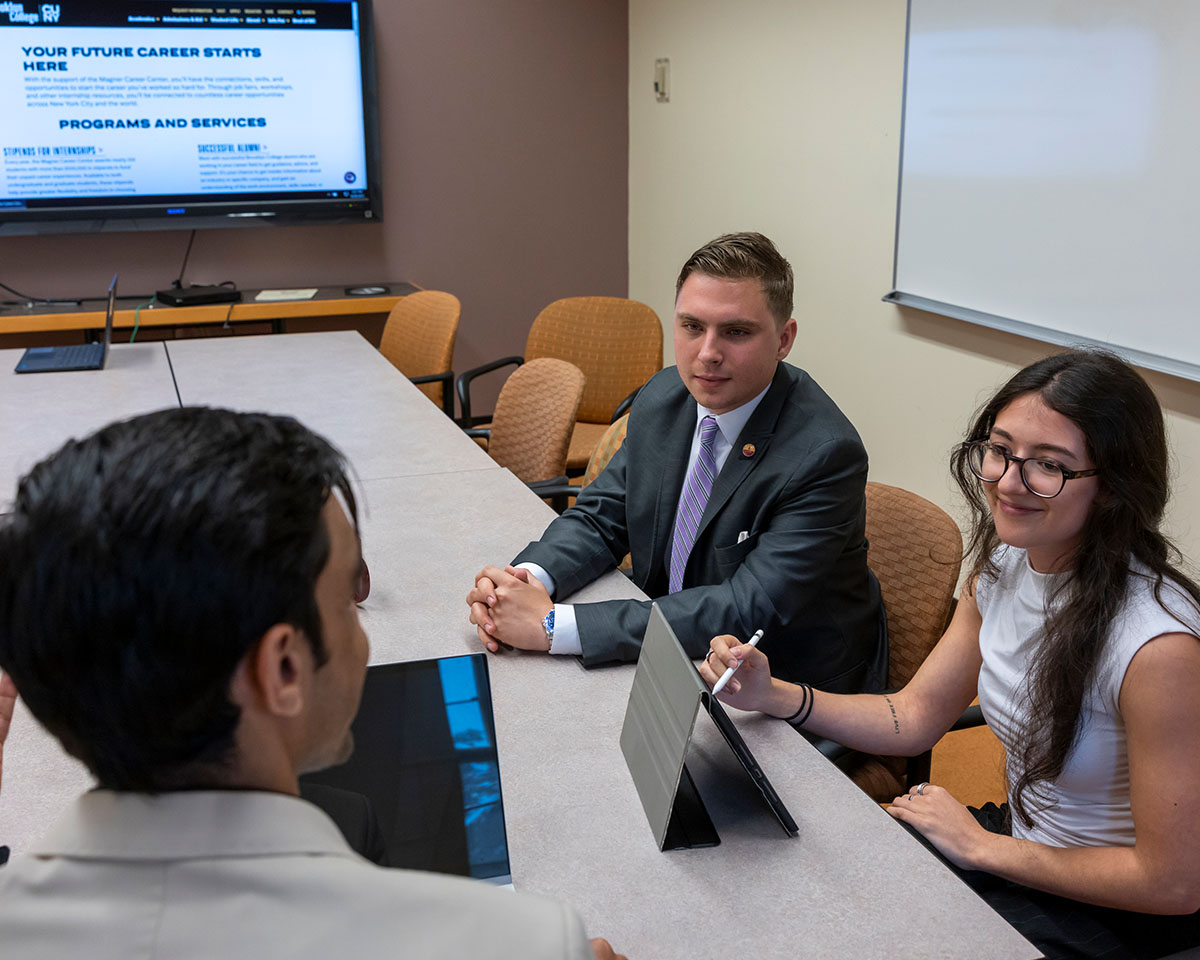
Through job fairs, the internship database, and internship panels, the Magner Career Center gives students in the urban sustainability B.A. program access to career opportunities at a wide variety of employers, including:
- AECOM
- Al-Madrasa Al-Islamiya
- AmerisourceBergen
- Brooklyn Greenway Initiative
- Downtown Brooklyn Partnership
- GHD
- Gran Kriegel Associates, Architects + Planners
- Green Mountain Energy Company
- Greenwood Cemetery
- Madigan Development
- New York Botanical Garden
- New York City Department of Design and Construction
- New York City Department of Parks and Recreation
- New York University Tandon School of Engineering
- NextShift Collaborative
- Open Plans
- Philips
- Regional Plan Association
- Sam Schwartz
- Transportation Alternatives