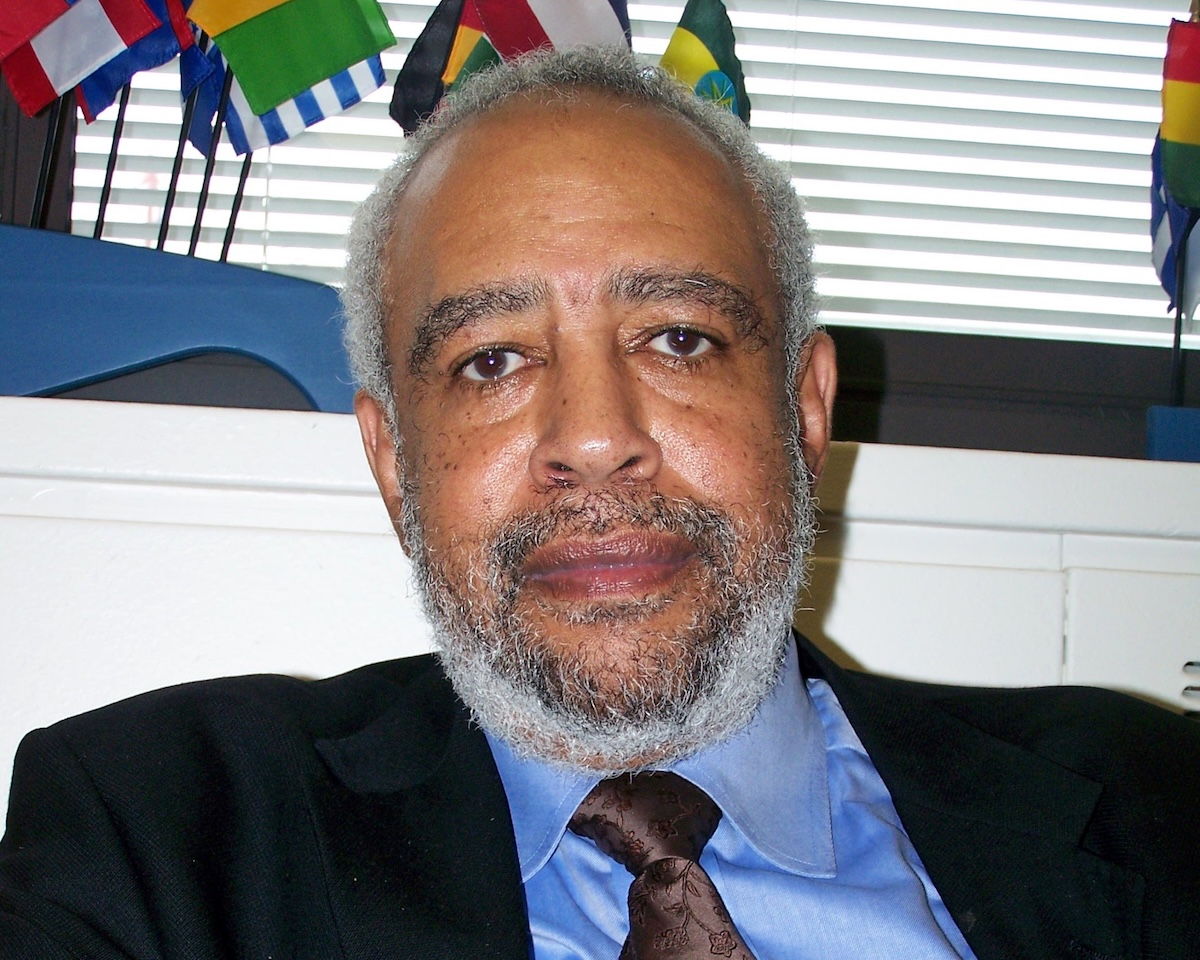
Professor George Cunningham was one of the first people I met at Brooklyn College when I interviewed in February 2012. When I saw him again in August, at the beginning of the fall semester, he told me for the first time, “We need you, brother.”
It is what he told me in every conversation over the last 14 years, although those words were often camouflaged in different ones. I never had to ask what that statement meant because I benefited from a few mentors throughout my life. Their sense of responsibility, generosity, and willingness to give everything they had—even on their worst days—could never be repaid. What George was telling me was a reminder of that same responsibility. Some forsake it; others carry it forward. The result is reflected in the thousands of students he inspired in his 48 years at Brooklyn College.
George Cunningham, who was born on May 15, 1948, and passed away on July 11, 2026, was both a molder of generations and a witness to them. It is our responsibility as an institution and a community to honor a career that spanned nearly half a century. We honor him not through platitudes, but through commitment and by ensuring that Brooklyn College becomes an even greater beacon of the sacrifice George embodied—for Brooklyn College, for the Africana Studies Department, and for every corner of the campus to which he dedicated himself.
As we honor his life, it is only fitting that the reflections of his former students and mentees are the ones that light our path forward. As colleagues, faculty, staff, and administrators, we may know each other in a certain way; however, as faculty members, we sometimes come to better understand ourselves through those we have influenced. What follows are the reflections of Brooklyn College alumni from 1992 to 2026. They paint the portrait of a legacy.
Modeling Humanism
Although Professor Cunningham was a towering intellectual and his classrooms were spaces of eye-opening engagement and discovery, being recognized as a father figure by many students demonstrates that he transcended the narrower role of simply teaching subject matter. Being a professor was not merely a profession; it was a calling to develop human beings.
Columbia University doctoral candidate Dane Peters ’09 captures Cunningham’s role in his life: “I would not see or experience the world the way I have these past 20 years if it were not for George Cunningham.”
Renowned author Robert Jones Jr. ’06 reflects, “He was the epitome of aplomb, intelligence, and grace. In many ways, he was the father I always wished for.” A consistent theme in the reflections of Cunningham’s students was the way he encouraged them. Robert continues, “I remember once when I was doubting myself and my skill as a writer. Professor Cunningham told me that it was ridiculous for me to feel that way because I was the best writer he had come across since Gloria Naylor, who was also a student of his.”
Recent graduate Harmonie Heath ’26 echoes this sentiment: “He consistently encouraged me to have more confidence when participating. His support helped me become more comfortable sharing my thoughts and trusting my own perspective.”
Several of Cunningham’s students and mentees became educators themselves, and it was the manner in which he conducted his classes that left a profound impression on them.
Trina Yearwood ’00, who was recently appointed President of the Brooklyn College Alumni Association, speaks about the lessons he instilled in her as an educator: “Professor Cunningham taught me that we can disagree without diminishing one another. Education is not about producing students who think exactly as we do. It is about cultivating critical thinkers, evaluating ideas on their merit, and respecting well-reasoned perspectives.”
Educator Maciel Rosario ’25 describes his influence: “He made me aware of making sure all voices are heard, and that students can actually conceptualize and retain the knowledge they are learning.”
What led Maciel to take several of Cunningham’s courses “was the fact that instead of being focused on rigorous testing with his students, he preferred for us to write essays or journals from our perspective, explaining what resonated the most with us or what profound knowledge would be valuable long-term.”
Care in Action
It is not simply what Professor Cunningham said; it is what he demonstrated through his actions—inside the classroom and beyond.
Professor Patrice Rankine ’92 never had Cunningham as an instructor. Yet, as a distinguished professor himself, he reflects: “George had been a mentor of mine throughout my years as a college student at Brooklyn, although I never took a class with him. I admired him profoundly. He was elegant and cool.”
However, the mentoring extended well beyond Rankine’s years at Brooklyn College and continued throughout his academic career. “George was pivotal to the publication of my first book, Ulysses in Black. This is the book that secured my tenure at Purdue University, but it also came to be seen as groundbreaking in putting the Greco-Roman classics in deep conversation with Black studies.”
Most significant was that George took the time to read and offer encouragement. “After I wrote the foundational chapter on Ralph Ellison’s engagement with Homer’s Odyssey during my first year at Purdue,” Rankine states, “I sent it to George. I’ll never forget his response, or his exact words. Not only was he engaged with what I had written—not necessarily a common response from mentors, who sometimes never read what people send them—George gave me the fertile soil for the growth of the book.”
It is important to note that Cunningham’s influence extended beyond the silos of our academic departments. Sometimes it was enough simply to be a student on campus and cross his path.
Master of education student Jermaine Fairweather ’00 remembers meeting Cunningham for the first time on Bedford Avenue. They were both wheelchair users later in Cunningham’s career. Jermaine recalls, “I will never forget the first day when I was getting off of Access-A-Ride and he was getting off of an accessible van. He asked me if this was my first time here, and I said yes. I didn’t really know much about Brooklyn College at the time, so he was like, ‘Follow me.’”
Known for his humor and wit, Cunningham immediately put Jermaine at ease. Jermaine continues: “I remember when we got inside and only one elevator was working, and he jokingly said, ‘Let me go first.’ But we both were able to get in. Then I asked him if he worked here, and he said, ‘What does it look like?’ That’s where our story began.”
Similar to Jermaine’s casual conversation with Cunningham, Dane recounts that what was supposed to be a 30-minute conversation expanded into two hours and ultimately a two decades-long relationship. It reminds us that responding to our students’ most urgent needs often begins with our availability and willingness to listen.
Dane reflects on the Great Recession of 2009: “I had just returned from Ghana as a study abroad student when the worst possible thing happened: I lost the job I had been counting on to finish paying my tuition during the worst moment in the economy.”
The consequences threatened to derail his future. “Without that payment, Brooklyn College held my transcript. I couldn’t find work and was barely getting by, but I needed to apply to graduate school. It was the only thing I cared about.”
Cunningham paid the remainder of Dane’s balance, allowing him to attend graduate school in Boston. He asked for nothing in return except that Dane “pay it forward.”
Witnessing
What does it mean to be a witness as Baldwin says? It requires a commitment to seeing and telling the truth.
Distinguished actor Damon Evans ’19, a fellow Baltimorean and contemporary of Cunningham, reflected on Cunningham’s unwavering commitment to truth. “I’ll never forget the class when he was teaching Harriet Jacobs’ Incidents in the Life of a Slave Girl.”
Recalling Cunningham’s words, Damon continues: “I’ve read this book countless times, and I didn’t want to believe it. But, class, it cannot be dismissed or denied, because that is precisely what Jacobs wrote in just a page and a half”—an account that revealed the gender and sexual violence which underscored African slavery.
Congratulations, Professor Cunningham. Your work continues through the generations you helped foster and through those who continue to serve as witnesses to humanity.of Africana studies and to confronting the complexities of history: “That one brief moment in class taught us not only how erotic Black literature could be, but also the hidden atrocities and horrors embedded in our history as well as the gift and wonder of our survival through time.”
Being a witness also means carrying the truth forward because it requires ethics and a sense of intergenerational responsibility. That is why, 25 years later, Yearwood still carries Cunningham’s influence: “Professor Cunningham taught me one of the most enduring lessons of my educational journey—that fairness and intellectual integrity must always guide my work as an educator. He challenged us to think critically, held us to high standards, and evaluated ideas based on the strength of the evidence rather than whether they aligned with his own perspective.”
Legacy
Black studies was formally established in 1968, during a pivotal moment in our nation’s history. The following year, in 1969, the Brooklyn College department was established in response to our own campus unrest. Cunningham served the department and the college for 48 of those 57 years since.
Undoubtedly, he fought many battles—winning some and losing others. However, we never lose when we pour into the lives of our students. As Jones states, by introducing him to some of the greatest literary minds, Cunningham “forever shifted my mind’s orientation toward a radically progressive politics.”
Congratulations, Professor Cunningham. Your work continues through the generations you helped foster and through those who continue to serve as witnesses to humanity.
Brooklyn College, Africana Studies, and Black Faculty and Staff will host a memorial honoring Professor Cunningham on campus on Tuesday, September 8. Let us come together to celebrate his life, his achievements, and his lasting legacy. If you have any questions, please email Black Faculty and Staff at .
Memorial Event Details: Tuesday, Sept. 8
Memorial Program: 5:30–7 p.m., Woody Tanger Auditorium
Reception: 7–8 p.m., Christoph Kimmich Reading Room