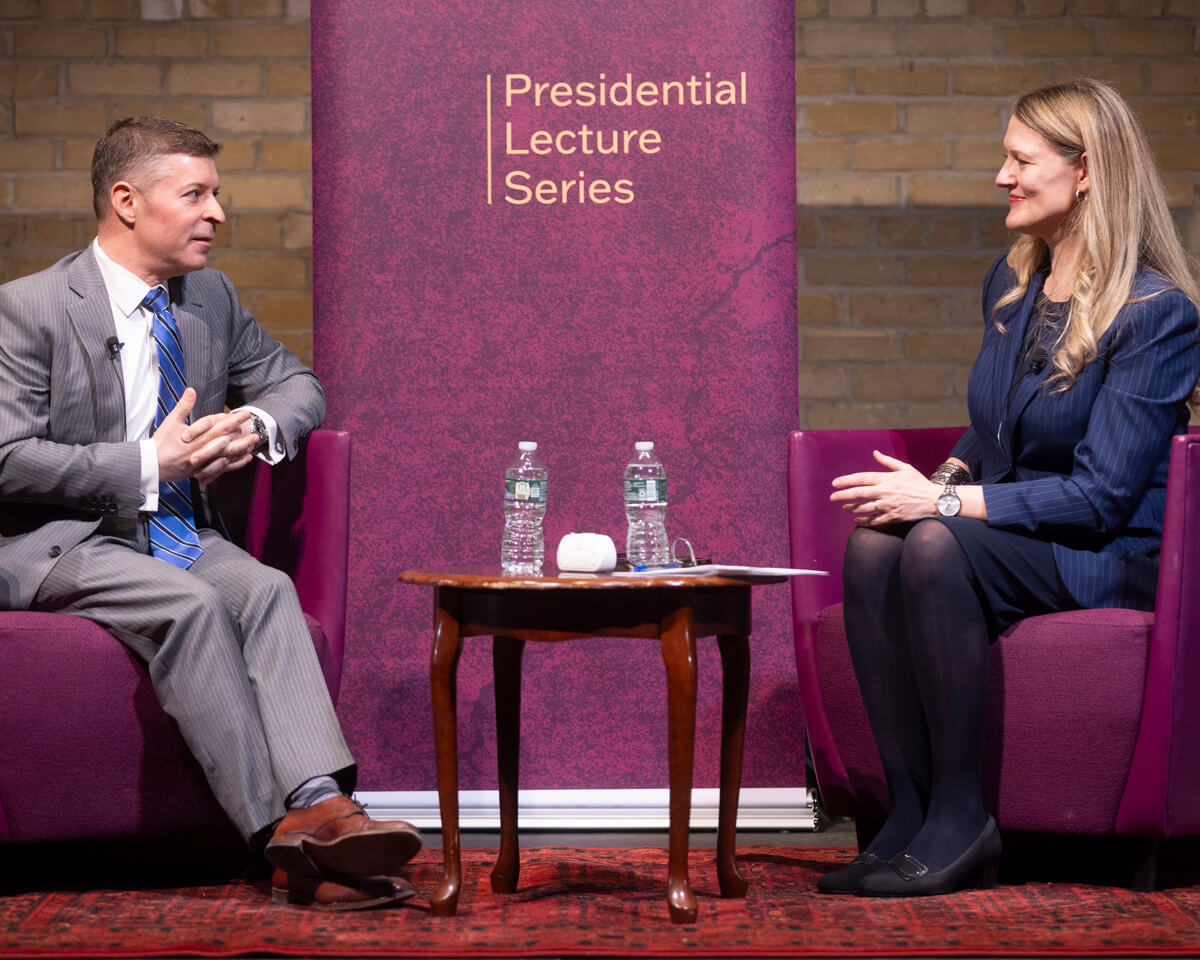
At a recent Presidential Lecture at Brooklyn College, President Michelle J. Anderson welcomed students, staff, and faculty to a timely conversation on public institutions, democratic norms, and professional integrity. The event reflected the college’s ongoing commitment to fostering thoughtful dialogue about leadership, public service, and the responsibilities that accompany institutional power.
President Anderson introduced Michael Ben’Ary, a former career federal prosecutor who served for nearly two decades at the U.S. Department of Justice (DOJ) across multiple administrations. Last October, Ben’Ary’s career took an abrupt and public turn when he was fired from his position at the DOJ, an event that raised questions about the department’s independence and highlighted the vulnerability of public institutions to political pressure. Ben’Ary spoke about the pressures facing public institutions, the importance of professional independence within the justice system, and the consequences of eroding public trust.
Central to the discussion was the relationship between public confidence and the effective functioning of the justice system. Ben’Ary emphasized that trust in federal prosecutions depends on a clear separation between politics and criminal justice.
“The separation between politics and the federal criminal justice system allows the public to have trust,” Ben’Ary said. “What is happening now, is the eroding of that trust, and eventually it’s going to make it harder for the Department of Justice to provide any measure of public safety.”
He described public confidence as a “reservoir of trust” built over decades by career prosecutors committed to following the facts and the law. When he began his career at the DOJ in 2006, Ben’Ary said he benefited from that legacy immediately.
“When I introduced myself in court as representing the United States Department of Justice, people believed me—not because of anything I had done personally, but because of the decades of prosecutors who came before me,” he said. “It took a long time to build that reservoir, and I’m concerned that it’s being drained.”
Ben’Ary warned that diminished trust can weaken the justice system’s ability to function effectively, making it more difficult to protect both public safety and national security. He noted that the DOJ encompasses far more than prosecutions, including agencies and programs that support communities, administer grants, and carry out public service missions.
“When trust declines,” he said, “all of that work becomes less effective. There should be confidence that when the department acts, it’s doing so because it’s good for the public, not that it’s based on a good thing for an individual, official, or that official’s friends and family.”
President Anderson invited Ben’Ary to reflect on professional ethics and leadership within public institutions, particularly during periods of political pressure. Ben’Ary shared his experience supervising teams of prosecutors and the importance of anticipating ethical challenges before they arise.
“I encouraged the attorneys I supervised to think ahead and know where their red lines were,” he said. “If you’re asked to do something that isn’t legal or ethical, you need to be prepared to say no.”
For students considering careers in law, government, and public service, the conversation offered a candid look at the ethical responsibilities that accompany institutional authority. Through events like the Presidential Lecture Series, Brooklyn College continues to engage the campus community in critical conversations about democracy, accountability, and the professional integrity required to sustain public trust.