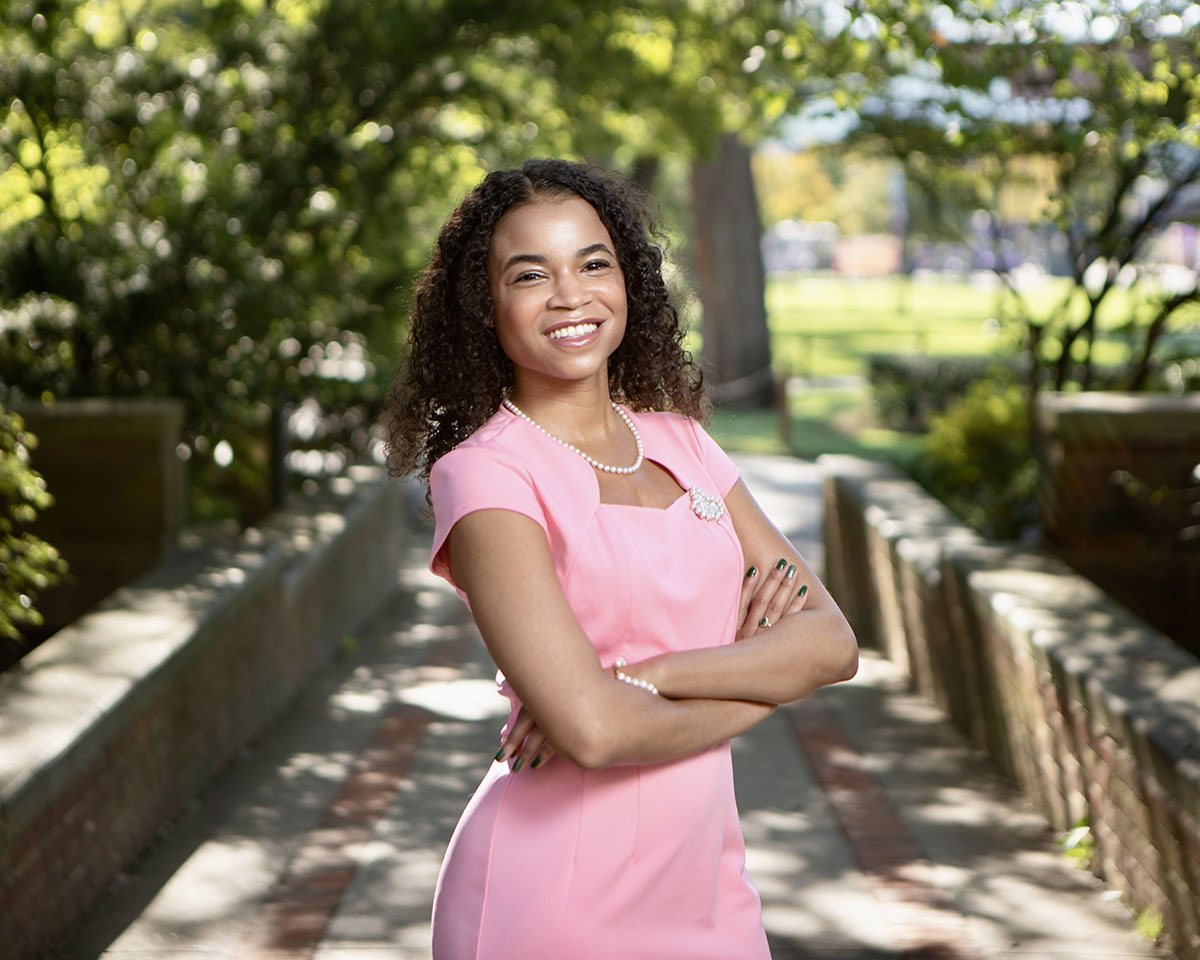
Alumna Ruqayyah Batts took a less typical route than many of her peers studying pre-med when she was accepted into the Coordinated B.A.-M.D. program. This eight-year combined bachelor’s/M.D. program allows students to be accepted into both college and medical school directly from high school. An introduction to Africana studies course was the spark that led her to choose that major for her bachelor’s degree, an education she has taken with her. A rising third-year med student at the University of Buffalo, SUNY, Batts is passionate about mentoring and supporting other students, especially those from underrepresented backgrounds who are pursuing careers in medicine. Here she speaks about her path to becoming a future physician, the people who have helped her along the way, the significant racial disparities and biases that persist in health care, and her plans to help remedy them.
Can you tell us about your background?
I’m from Brooklyn, born and raised. I come from an Afro-Caribbean background All of my higher education has been in public universities, including CUNY and SUNY. I knew in high school that I wanted to become a doctor. I met with my guidance counselor frequently, and she told me about the Coordinated B.A.-M.D. program at Brooklyn College. It’s a competitive program, and I wasn’t entirely confident I’d get in. Still, Brooklyn College was my first choice because I heard it was strong in the sciences.
What was the appeal of that program?
One of the main attractions of the B.A.-M.D. program is that I was encouraged to major in something other than science for my bachelor’s degree; Brooklyn College wants you to be well-rounded. I thought about psychology, but then Africana studies popped into my mind. I took an introduction to Africana studies class and fell in love with it. I asked myself, given my path to medical school, when else would I be able to immerse myself in Africana studies? There wouldn’t be another chance.
Can you name some of your mentors?
The entire Africana Studies Department was incredibly supportive. There were so many people I met along the way to earning my degree. Prudence Cumberbatch, who is today department chair, was my first. She was the one who encouraged me to minor in health and nutrition sciences, which complemented my pre-med studies. She also helped me with my thesis on art therapy and healing. [Associate] Professor Dale Byam invited me to be a part of the I Am Africana project, a conference held in May 2023. I was one of four alumni from the Africana Studies program, featured.
I joined the Black Student Union, and we helped bring the NAACP back to campus after it had been absent for 15 years. [Adjunct Assistant] Professor Trina Yearwood served as the club liaison for both the Black Student Union and the NAACP. That’s how I met her. Professor Lynda Day taught a fantastic course that I took, Black Women in America. My professors and mentors wrote letters of recommendation for medical school on my behalf. They’re still very much a part of my life.
Have you decided if and in what you want to specialize?
I’m considering emergency medicine; that’s what I’ve always wanted to do. It’s underrepresented when it comes to Black and Latinx doctors. You see infuriating statistics in medicine. There was a survey of White medical students in 2016 asking them about White versus Black patients when it comes to pain. Half of the students surveyed believed that Black patients had thicker skin and had less sensitive nerve endings than White patients, so they needed less pain medication. These beliefs, which die hard, were carried into medical practices when students became doctors, and that is one of the reasons Black patients have been undertreated for pain.
You mentor in your free time.
Mentoring is a big part of my life. Even when I don’t really have time, I still try to do it because, it may sound corny, it really made a big difference in my life. When I applied to medical school, the main person helping me was a close friend from high school who was a podiatry student. That was the closest person to medicine that I had access to.
There are many times that premed students approach me and ask for help, and there’s no way I can say no because I was given help. At SUNY Buffalo, I was a grad assistant and a teaching assistant for CSTEP [College Science and Technology Entry Program]. That program exists to increase the number of underrepresented students in STEM fields. I also worked at Success Academy in Flatbush. I was an adjunct professor for the NYU Tandon K–12 STEM Education program and taught high school students science ethics.
I always welcome those opportunities because there’s so much that people don’t know and don’t have access to. Many of my classmates have parents and grandparents who are physicians. They come from multigenerational families of doctors. I think for those who don’t have people in their family who went to medical school or even college, it’s a totally different ballgame. You’re making your way by trial and error, and that is very hard to do in medical school.
What advice would you give an incoming first-year student at Brooklyn College?
It definitely depends on what major they choose. If they’re pre-med, I would say settle in first, get your coursework done, then join the clubs. But definitely get involved. That was the highlight of my college experience, the different clubs and activities that I was able to take part in. Although sometimes it was stressful juggling extracurricular activities with school, the friends that I made and the mentors that I met and stay in touch with are still a big part of my life. Even though Brooklyn College is a commuter school, it didn’t feel like one because I was so involved on campus. So yes, get involved. Find your people.