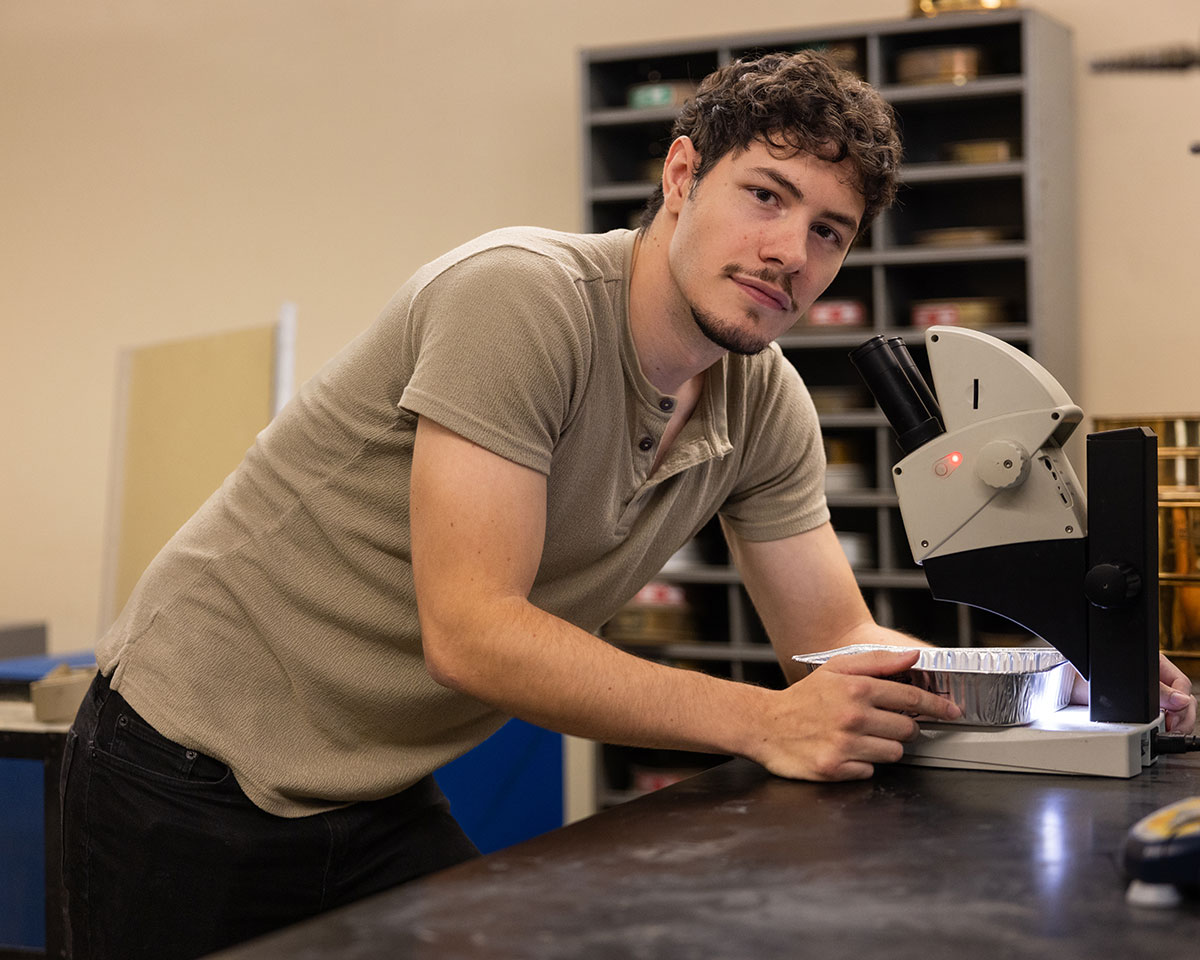
Senior Carlos Baez decided to pursue his long-held interest in paleontology when he transferred to Brooklyn College. Through research opportunities and summer fieldwork funded by a Magner Career stipend, he has gained valuable hands-on experience in paleontological methods. He has been given the chance to present his findings at the Geological Society of America.
Can you tell us about your background?
I grew up in New Jersey. Both of my parents were in the military, which meant a lot of moving to other states. So, I had to adjust to a lot of different schools, people, and cultures, and try to find my place. I first attended the College of Staten Island to pursue a business degree, then I transferred to the Borough of Manhattan Community College for forensic science, but something wasn’t clicking. I took a step back and thought about what I really want to do. I have always been interested in dinosaurs and paleontology, even as a child. So, I decided to transfer and give earth and environmental sciences a shot, and Brooklyn College has a great program.
So, paleontology is now your field of study?
Professor [Matthew] Garb got me into it. The earth and environmental sciences program and faculty are amazing. The program at Brooklyn College is growing and becoming increasingly important in light of our changing climate. I wanted to do things outside of my classes, and he informed me that there was summer fieldwork and lab research available. He let me know that an alumna, Anastasia Danilova, a museum specialist at the American Museum of Natural History, was working on a project and would occasionally visit Brooklyn College. He told me I could work on fossils and sediment samples that she had brought back from a site that she was too busy to process herself. He taught me how to properly sieve the sediment so that the contents of it were easier to see under the microscope. He also taught me how to interpret what I was seeing in the grain samples under the microscope. Grain sizes and fossils tell us a lot more than we may think. He helped me understand how certain fossils or grains could tell us what was happening to the environment 66 million years ago during a major extinction event. This all prepared me for a trip to the Gulf of Mexico last summer.
Where specifically did you work?
Professor Garb, Anastasia, and two of my fellow students did paleontology fieldwork in Mississippi and Alabama, and in late July, we went to South Dakota. We were looking for fossils to help identify environmental changes and to determine how the environment in the past compared to the present. We were working specifically with ammonites [shelled cephalopods that died out about 66 million years ago]. In Mississippi, we found something pretty unusual—thousands and thousands of fossils in one small area. My work will serve as the basis for a presentation I will give at the Geological Society of America Annual Meeting this fall.
Working with mentors like alumna Anastasia Danilova mentor is a “full circle” moment. She was able to conduct her fieldwork on a Magner Career Center stipend while she was an undergraduate.
The Magner Career Center stipend also funded my internship at the museum and will partially cover the cost of my trip to the GSA meeting.
What’s next after graduation?
My plan is to go to grad school. I immersed myself in paleontology, but at the same time, I want to explore different avenues.
Do you have any advice for your fellow students?
You shouldn’t be afraid to try something new. I feel like many people are ashamed of doing that, resetting their major if something doesn’t click. Deep down, you always know where your heart’s at. So, when you really know what you want to do, network with like-minded people, and that will take you down the right path. Opportunities will open up when your heart’s in it. Don’t do what you have to, do what you want to. Form study groups with like-minded students and never be afraid to ask questions.