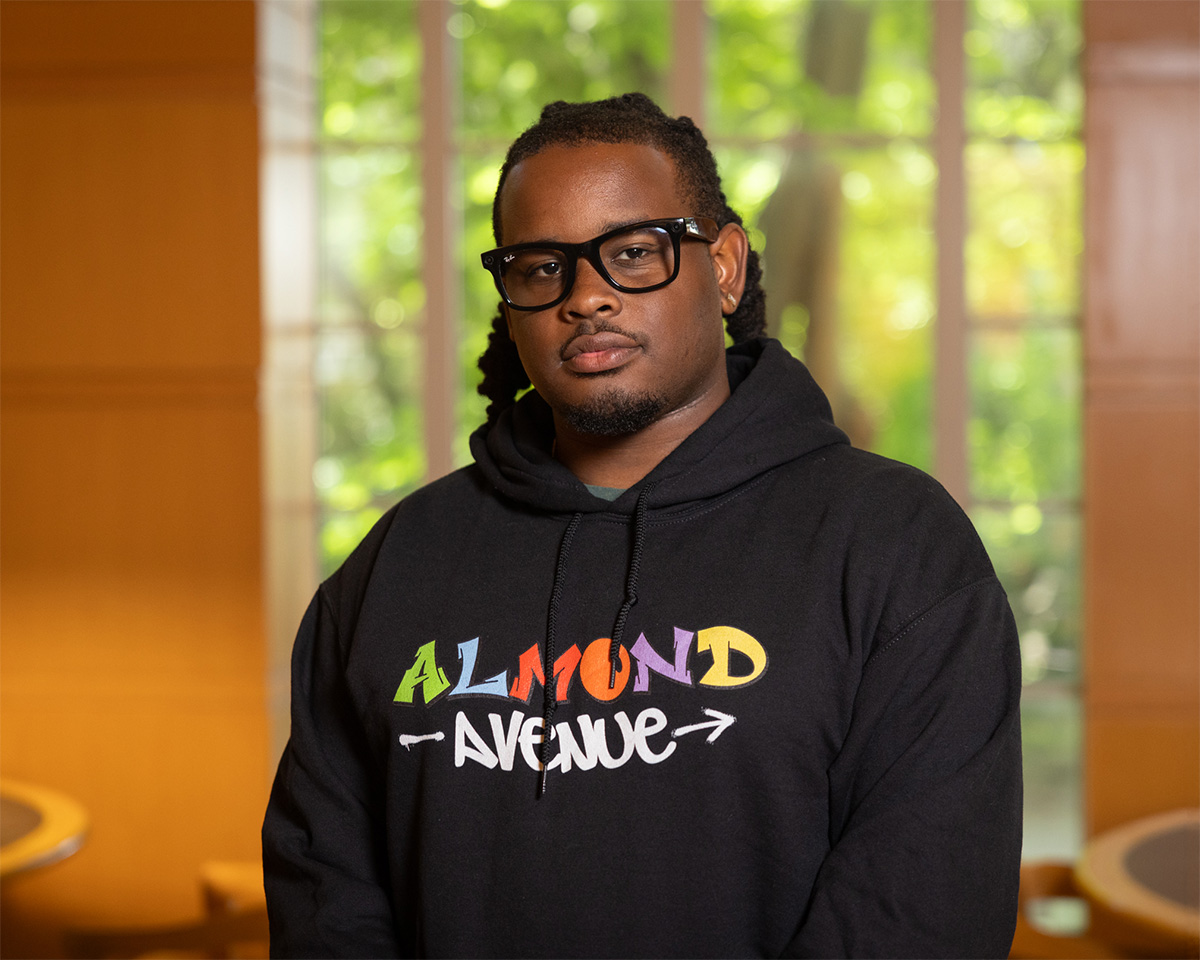
Fresh off graduation in May, filmmaker Javon Garnett ’26 is already making waves with his senior thesis project, Almond Avenue, an independently produced puppet comedy that imagines a decidedly adult version of a world inspired by children’s television. Created on a modest budget and fueled by an ambitious social media strategy, the project has attracted growing attention both online and within the entertainment industry.
We spoke with him about filmmaking, finding his audience, and what’s next.
When did you first realize you wanted to be a filmmaker?
I got interested in filmmaking around 2014, when YouTube creators were really starting to take off. Seeing young people making videos and building careers from them inspired me. I started doing media work at my family’s church, handling cameras and visuals, and that gave me my first hands-on experience.
I went to high school at the Academy for Careers in Television and Film in Long Island City. That gave me a foundation in filmmaking.
What was your experience like in the film program here?
It definitely shaped me. This program is very rooted in traditional filmmaking, which is not my style. Honestly, as a Black filmmaker with a very different style and perspective, there were moments when people didn’t fully understand what I was trying to do.
At the same time, there were some key people in the department who always encouraged me to pursue my vision. There were a lot of experiences that taught me independence, in a good way. I learned how to trust my own voice and move forward even when not everyone saw the vision. That’s a lesson I’ll carry for the rest of my career.
Who were the key people who had a particularly positive impact on you?
[Professor] Mustapha Khan and Judith Kenny ’13, [the department’s director of academic affairs and operations], were huge influences.
Professor Khan immediately understood what I was trying to accomplish with Almond Avenue. He told me, “This seems exactly like you,” and he encouraged me to lean into the project.
Judith helped me think about my motivations as an artist. She challenged me to create from a place of purpose rather than simply trying to prove people wrong. That advice really stuck with me.
Tell us about Almond Avenue. Where did the idea come from?
The concept started with an old Dave Chappelle joke about how strange Sesame Street would be if it were an actual neighborhood. I heard it years ago and couldn’t stop thinking about it.
Eventually, I developed my own version of that idea. In my world, familiar archetypes become exaggerated adult characters. It’s a comedy, but it’s also a commentary on the environments and personalities we encounter in everyday life.
You produced the project independently. How did you make it happen?
Very carefully and very cheaply.
My sister works in production. She helped me think through the logistics. My former high school also loaned me equipment for much of the shoot, which was a huge help.
I own a photography and videography business, so I used money from that to purchase my own camera, sound equipment, and editing setup. In total, the project cost about $700 to produce. I’ve since made that money back through merchandise sales connected to the project, which was amazing.
How have audiences responded?
Better than I could have imagined.
I’ve screened the film several times in front of completely different audiences, including at Brooklyn College, at my high school, and in the community. The reactions have been very positive. People laugh, engage with the characters, and want to know what happens next.
The first public screening was especially emotional for me. Honestly, it felt more like my graduation than graduation itself. Seeing people connect with something that started as an idea in my head was surreal.
What’s next for Almond Avenue?
Right now, Episode 1 is out, and I’m working on Episode 2. The long-term plan is six episodes, although I’d love for a studio or production company to become interested before then.
I’m also using social media heavily, releasing short commercials, skits, and promotional content between episodes. That strategy has helped me build an audience and keep people engaged with the world of the show.
I’ve been talking to a lot of people in the industry, too. The actor who plays the main character in the show happened to be at an event with [actor and comedian] Craig Robinson. He ended up introducing me to him. I gave him my 30-second quick pitch, and he put me in touch with his agent at 3 Arts Entertainment, which is a huge player in the industry. So, we’re in talks. I’m not saying they’re going to pick it up, but they’re looking at it, which is very exciting for me.
That’s huge! Good luck. What are your ultimate goals as a filmmaker?
I want to be an independent filmmaker with real recognition and impact.
I admire creators who have built their own platforms rather than waiting for someone to give them permission. That’s the path I’m trying to follow. Whether I’m making films, creating new stories, or mentoring future artists, storytelling will always be at the center of what I do.
At the end of the day, I want to create work that connects with people. That’s the goal.