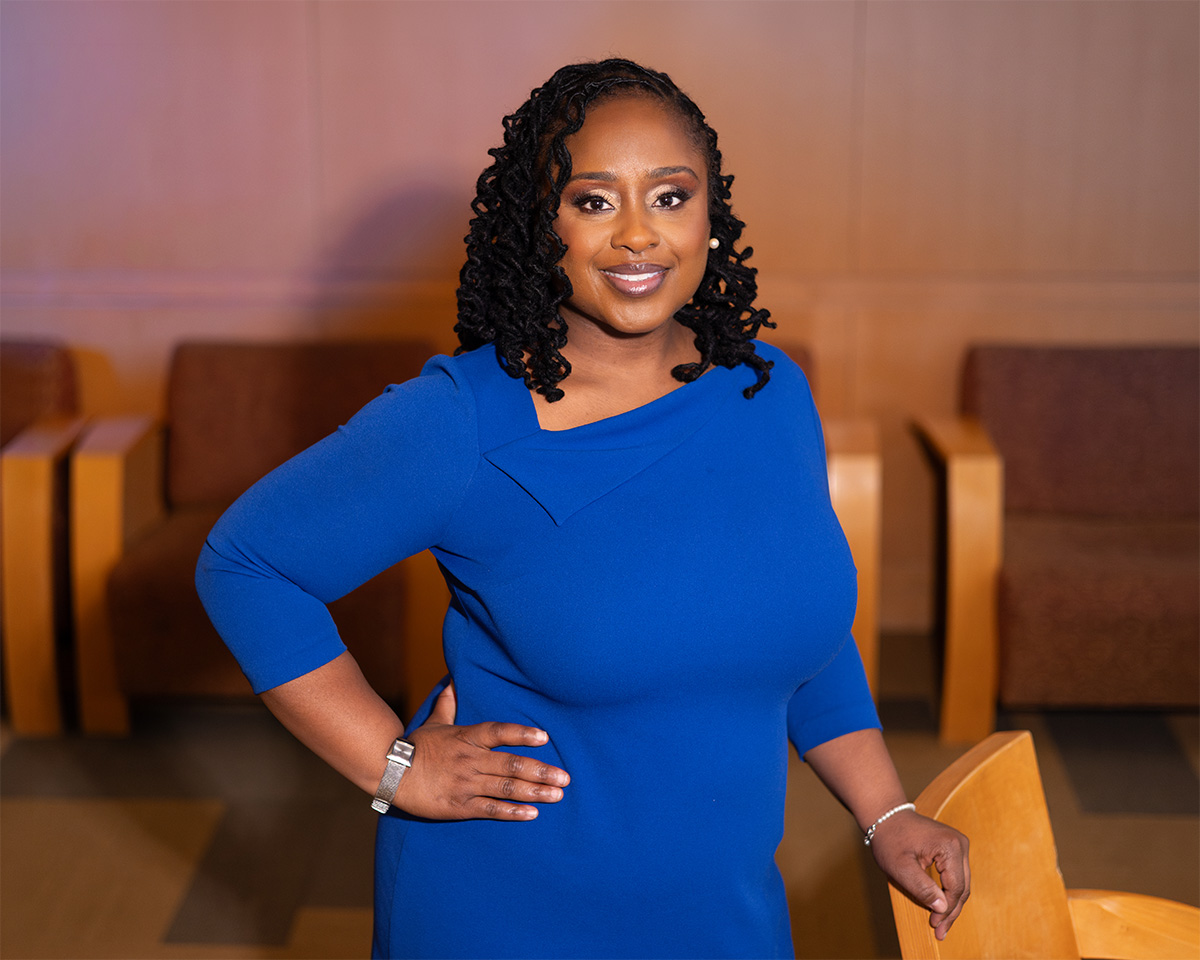

English Department Chair Martha Nadell at a recent convening about AI.
Science fiction has long imagined artificial intelligence, but few could predict the scale and speed of its real-world impact. Today, AI is reshaping every sector, sparking both excitement and unease.
At Brooklyn College, faculty and staff are navigating this transformation in real time. We spoke with three faculty experts—Martha Nadell (English), MJ Robinson (Television, and Radio & Emerging Media), and Karen Stern-Gabbay (History, Roberta S. Matthews Center for Teaching and Learning)—who shared how the college is responding.
Here, they discuss AI’s influence on classroom learning and how both learners and educators are preparing for an AI-driven future. Responses have been edited for clarity.
What was the initial reaction to AI by your colleagues?
Martha Nadell: Late in 2022, when ChatGPT first made headlines, academia seemed to lose its collective mind; the Great AI Panic of 2023 was about to begin. Some of my colleagues immediately went apocalyptic, imagining a world in which AI took over. A few were ready to have AI integrated, somehow, into their brains. But others stuck their heads in the sand and pretended it didn’t exist.
How have you seen AI take shape in the classroom?
Nadell: Early on, it was very easy to spot generative AI-produced work. ChatGPT was producing solidly mediocre work, C+ at best. The problems were obvious: deeply conventional language, workaday structures, and unoriginal thought. Some students were offloading their cognitive work to a pattern-matching machine, which could produce prose that possessed an air of authority, if only you didn’t read too closely.
MJ Robinson: As a journalism professor, I teach, per Phil Graham, that journalism is the first rough draft of history. So, in one respect, the students I teach are writing the history of AI—in culture, society and their anticipated industry and practice but—and here’s the difference: that technology can also be writing it with, or prompted by, them. So that’s an interesting conundrum.
I started including AI modules in my Journalism Capstone course in Spring 2023. From the beginning we were examining how journalism was covering the release of ChatGPT to the general public as well as interrogating how it was affecting the journalism industry itself and considering how these text-generating technologies will affect the future of journalism as an industry and a public good.
How should a college education prepare students for this new world?
Karen Stern-Gabbay: It is unclear what sorts of preparation students have for working with AI (agentive and otherwise) when they enter college. Colleges today, therefore, play a critical role in establishing expectations and setting rules for the game. We are uniquely positioned to encourage students to interrogate their assumptions about authorship and intellectual property, and to reinforce how essential it is to develop human skills (related to critical thinking, emotional intelligence, analog skills, etc.). College students have opportunities to practice responsible AI use inside classroom settings before these skills in the workplace.
Nadell: Universities are where critical thinking happens, and where students can recognize the limits of what AI is good at–predicting the likelihood of common and formulaic arrangements of language and thought—and can think through ethical quandaries with empathy.
How important is it to develop AI literacy among educators?
Robinson: We will, shortly, be in a world where K-12 educators have been educated in the age of AI and teaching children with these technologies from a very early age. That’s going to make critical AI literacy even more important. Asking questions about why one is using generative AI for a particular task prior to using it, insisting upon human-in-the-loop processes, knowing what one does not know about these platforms—these are key.
What have you and your colleagues been doing to enhance the understanding of AI on campus?
Stern-Gabbay: At the Roberta S. Matthews Center for Teaching and Learning we have hosted events and workshops during the past year that particularly engage with the complex roles of AI in the classroom. Of course, academic integrity and data privacy appear to be the biggest issues that we have explored, but several of our faculty (rightly) point out the environmental impact of big data associated with AI.
I do think, however, that discussions of AI in the classroom bring into starker relief topics that we should be discussing anyway, including the reasons why college classrooms have become more invaluable than ever—that is, to engage in and strengthen students’ critical thinking skills—these are invaluable in an increasingly automated and AI driven world.