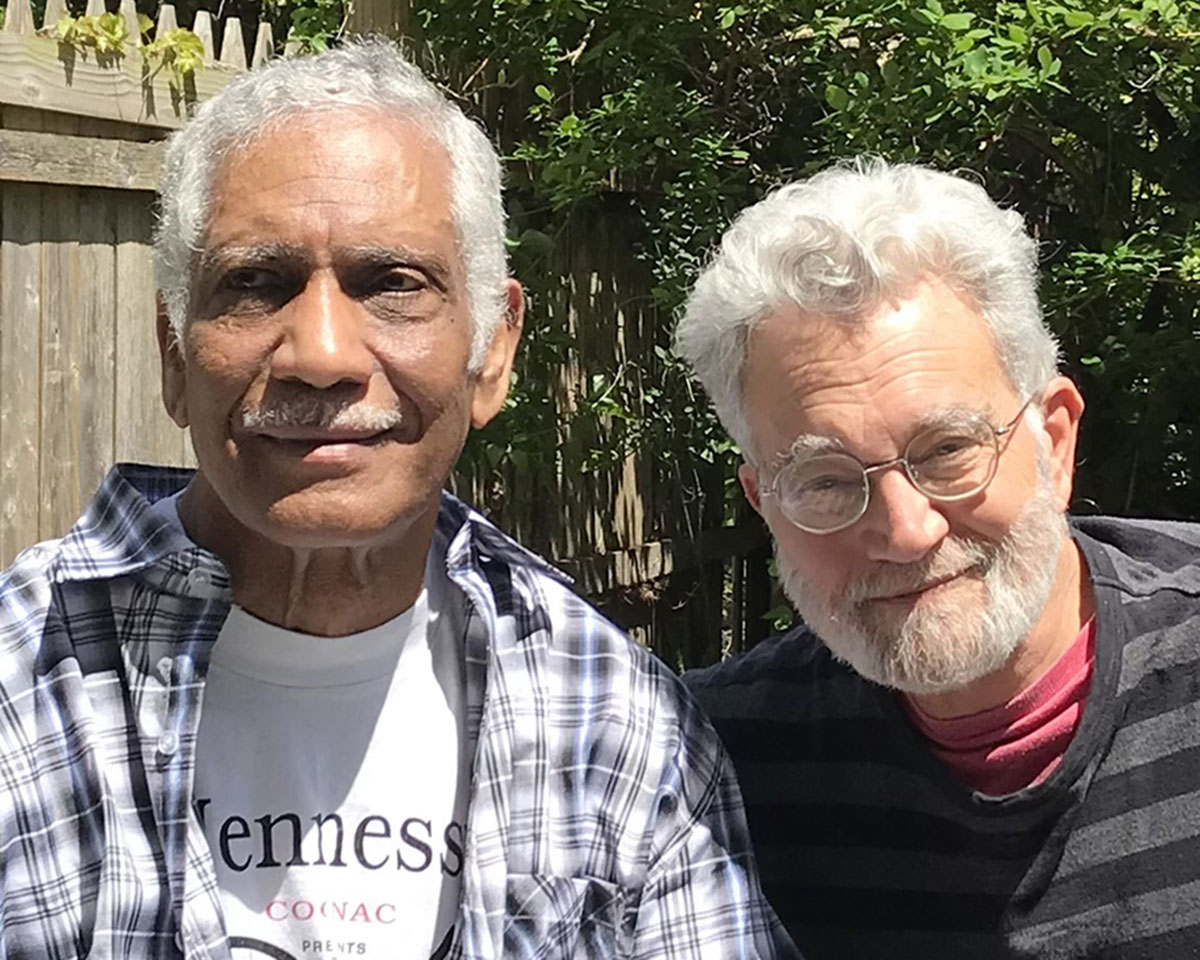
As a child, Caribbean-born Frankie McIntosh ’76 was encouraged by his musical family to learn piano. In 1968, he moved to New York City to study at Brooklyn College’s Conservatory of Music. But McIntosh’s plans to become a working pianist changed when a Calypso musician asked him to fix a score for an upcoming performance. It was the start of his becoming a highly in-demand arranger for top calypso and soca stars and record labels. With all his success as an arranger, McIntosh has never stopped performing and recently coauthored a book, Frankie McIntosh and the Art of the Soca Arranger, with Conservatory of Music Professor Emeritus Ray Allen. Here, they discuss McIntosh’s musical journey, the challenge of getting academic recognition for Caribbean musical forms, and thoughts about and advice for today’s younger generation.
Can you tell us about your background?
I was born in St. Vincent and the Grenadines in 1946. Growing up on a small island in a small community gave me a strong sense of identity, which has prevailed throughout my life. I would walk down the main street in Kingstown, the capital, and I would recognize eight out of every 10 people who passed by, and they would know me. So I always felt a sense of belonging. The culture, food, music, festivals, Carnival, and so on brought people together.
My grandfather was a musician, and all his children took music lessons. My father, an accomplished pianist and saxophonist, started a band called the Mellotones. When I was about nine, I played in the band. We played at local dances, concerts, and the like. We played calypso, of course, as well as boleros, cha-cha-chas, merengues, and lots of jazz standards. From the Mellotones, I formed my own band at age 14. Most of the members of the band were my friends and classmates. We played for school functions, socials, and so on. When the school was having a function, they’d say, “Oh yeah, Frank McIntosh has a band, they’ll play for free.”
What brought you to the United States?
I planned on studying music on the university level. The University of the West Indies did not have a music major. From St. Vincent, I went to Antigua, where the work for musicians was more plentiful. From there, I applied to Brooklyn College. I had considered other options like Juilliard and Berkeley. Still, I chose Brooklyn College because of its broad range of course offerings. I could do music and take classes in chemistry. I was a piano major. Did theory and music history, the whole shebang.
When did your career as an arranger begin?
It began around 1976 with artists from St. Vincent, starting with a Calypsonian named Becket (Alston Becket Cyrus). He approached me about correcting some music he was performing in Brooklyn. Whoever had written the music made some errors. So I corrected it. At his next rehearsal, everything flowed smoothly, so he came back to me and said he would like to record an album. And he sang a song for me. Now I didn’t realize it at the time, but Becket was one of the pioneers of the new soca (soul/calypso) style that combined older calypso with influences of Black American soul, rock, and disco. We went to the studio, and we recorded the first song, “Coming High.” A producer in the studio, Buddy Scott, had connections with major record labels, and he secured a deal for Becket with Casablanca Records. That album did very well. One of the songs, “Calypso Disco,” was in the movie The Deep.
That catapulted my career. Everyone started calling from all the islands—an artist from Trinidad named Crazy, Winston Soso from St Vincent, and King Short Shirt from Antigua. Then came Explainer, Chalk Dust, and Calypso Rose from Trinidad. That gave me a broad overview of calypso as a whole, because before that, calypso was defined as being only from Trinidad. But now we had singers from Antigua, St. Vincent, and St. Lucia.
Tell us how you became the in-house arranger for Straker Records.
Frankie McIntosh
I had known [music businessman and record producer] Granville Straker in St. Vincent. He had a well-established record store in Brooklyn on Utica Avenue. When he signed artists to his label, he sent them to me to do the music. That went on for years, starting in the early 1970s. As the staff arranger for Straker’s Records, I arranged virtually all his music.
I didn’t have an exclusive contract, so I worked with several other independent labels. I recorded an album for the Mighty Sparrow and Lord Kitchener, which Charly Records produced. Small labels hired me to do work, and that’s how I was able to feed my family.
Ray Allen
Interestingly, all this is musical activity occurred within a very small radius of a mile or two in Bedford-Stuyvesant and Crown Heights, where record shops run by West Indian producers Rawlston Charles and Granvilee Straker were located. Right down the street was Eastern Parkway, where the big Carnival parade happened, and there were many dance halls and clubs in the area. It was a very active place for Caribbean music back then.
Professor Allen, your research focuses on American folk and popular music, including Caribbean Carnival music, with a particular interest in New York City music culture.
I had spent several years gathering information and writing a book on Caribbean music that was eventually published as Jump Up! Caribbean Carnival Music in New York City [Oxford University Press, 2019]. The focus was on the steel band and calypso music that were central to Brooklyn’s Labor Day West Indian Carnival. During my research, I attended a calypso concert, where Frankie was performing. I was really impressed. So I went up and said, “Hey, I teach at Brooklyn College.” We laughed that we had something in common. Later, I interviewed him for the Jump Up! book, and he talked about his work as an arranger of soca and calypso music.
My next project was going to be a book about Brooklyn soca, because the borough was the center of this music from the late 1970s through the 1990s. All the best recording studios, as well as several independent record labels, were in Brooklyn. Frankie was the perfect person to collaborate with because he was in the middle of it, the in-house arranger for so much of soca music that was coming out of Brooklyn. Nobody had ever written about the arrangers—all the books are about singers.
Have calypso and soca music received the kind of recognition and attention from music scholars that other genres of music have?
Ray Allen
The study of world music has developed significantly over the last three decades, and there is now recognition of various genres like Caribbean music. But there is more work to be done. For example, much has been written about Latin music, music from Cuba, salsa, and reggae, but calypso and soca have not made it onto the stage in terms of music that’s recognized outside the Caribbean. Most music fans know the reggae star Bob Marley, but how many have heard of the calypsonians Mighty Sparrow and Lord Kitchener? We hope that this book will put more focus on calypso and soca music from the English-speaking West Indies and that this will help to broaden the kind of work done in academic research.
By the way, when Frankie arrived at Brooklyn College in 1969 there were no courses in world music, Caribbean music, or jazz. In fact, students who wanted to play jazz had to hide out in the basement of the old Gershwin Hall because they were afraid their music professors would not approve. But fortunately, that has changed. Today the Brooklyn College Conservatory offers classes in jazz history, African American music, and world music. And most importantly they run a jazz ensemble so their students can gain firsthand experience playing the music.
Frankie McIntosh
Most books on calypso take a sociological bent, more in the frame of ethnomusicology. What makes our book different is that we deal with the music as sound. You’ve got harmonies and orchestration. There’s an appendix with chord charts for most of the songs—Ray had the patience to do that. I think it was appropriate for us to address the music. Not that other factors, like social and historical setting, don’t come into play, because there’s an introduction to each chapter. However, our book includes aspects such as the small talk among musicians in the studio before recording. For example, we illustrate all the steps from the artist presenting a demo to the arranger, and the arranger’s considerations before writing a note. I would ask myself what the artist expects: Does he intend to deliver a political message? Is his music for dancing? Is the emphasis on drums and bass? Should I put more focus on the horns? All those things are detailed in the book, which I think is what makes it unique.
Ray Allen
By the way, all the songs we discuss in the book are on YouTube and a listening guide is provided for those who want to delve deeper into the music.
Frankie, you worked with young people—do you see yourself as a mentor?
Frankie McIntosh
Well it’s funny, because these days, I’m the one who often needs the advice. You see, in today’s world, the definition of music itself has changed. You have rap where there’s no melody, and computers have replaced pencil and paper. So increasingly I find myself looking to young people for guidance, for instance, on selecting music software. They tell me about what these programs can do. And I admire their business approach. They publish and promote themselves. They create their own record labels, whereas my generation just sat and waited to be discovered.
Now in answer to your question, if I were to offer advice or mentorship to younger musicians, I would say that sometimes life has other plans, and it may become necessary to divert or modify your original objectives. Being prepared to make a significant shift, as I did from aspiring to be a pianist to becoming an arranger, is crucial. Because being a pianist would not have supported my family, it’s all about being open-minded and reassessing your priorities to determine what’s truly important.