David Hochman
It began with a chance encounter.
The scene: on board one of the many passenger liners crossing the Atlantic in the late 1940s and early 1950s. Enter Eleanor “Lee” Bell ’49 and Stanley Hochman ’49. They recognize each other…they think.
“Don’t I know you from Brooklyn College?” each wonders.
It turns out they have more than an alma mater in common. Both are returning home from extended time in France: she teaching at a girls school in Brittany, he studying at the Sorbonne on the GI Bill. Both are smart, intellectual, and curious about the world.
In this way, their voyage home also becomes a beginning: Soon a couple, they marry two years later.
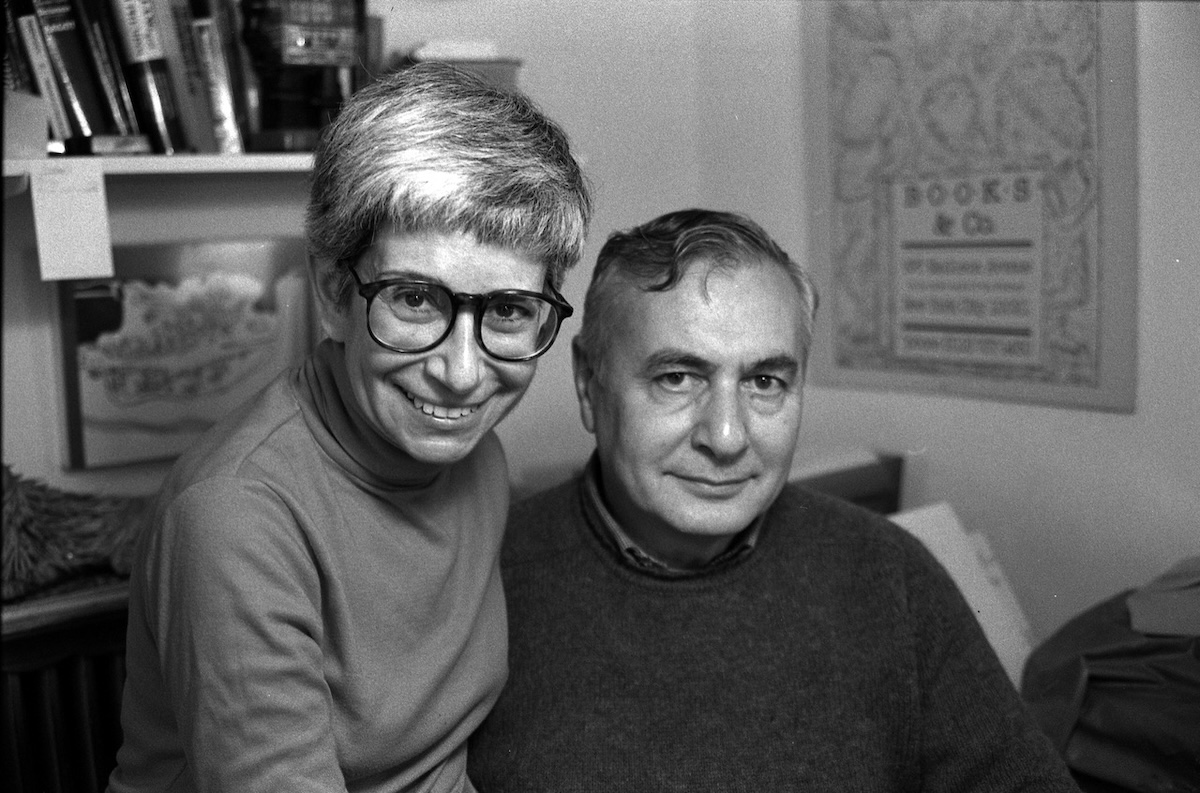
Photo Credit: Lütfi Özkök. Lee and Stanley Hochman in their Manhattan apartment in the 1980s. The photographer, Lütfi Özkök, was a friend whom Lee Hochman met in Paris in 1949; now internationally known for his portraits of writers and artists, he was a student at the time.
A Generous Choice
This story has long been cherished lore in the Hochman family—with the Hochmans’ son, David, later coming to understand how deeply important a Brooklyn College education had been to his parents. It had provided a foundation for their life’s work as editors, translators, and writers.
And so, after his parents’ deaths, David Hochman and his wife, Dr. Eugenia (Genie) L. Siegler, professor emerita of clinical medicine in the Division of Geriatrics and Palliative Medicine at Weill Cornell Medical College, made a generous choice: to create two funds in Lee and Stanley Hochman’s honor for Brooklyn College students in the School of Humanities and Social Sciences.
Hochman and Siegler’s gift establishes The Stanley Hochman ’49 and Eleanor Bell ’49 Hochman Scholarship Fund, which will provide tuition assistance for undergraduates studying in the School of Humanities and Social Sciences who demonstrate financial need, and The Stanley Hochman ’49 and Eleanor Bell ’49 Hochman Research and Development Fund. The latter provides financial support for undergraduates studying in the School of Humanities and Social Sciences to engage in travel, research, mentorship, artistic expression, community engagement, or any other opportunity that allows students to gain hands-on experience bridging their classroom with the world outside.
This act of generosity reflects David Hochman and Genie Siegler’s desire to make the kind of opportunities Lee and Stanley Hochman had—opportunities that allowed them to envision and then inhabit intellectual lives—accessible to more people. Having attended Brooklyn College when it was tuition free, his parents would have been thrilled, David says, to provide “support for families that have limited means but high ambition”—families like both Lee and Stanley Hochman’s own in the 1940s.
Not (Yet) Friends
Lee Bell, later Hochman, graduated from Fort Hamilton High School in 1945, enrolling in Brooklyn College that same year. Stanley Hochman graduated from Erasmus Hall High School in 1942, then served in the U.S. Army’s 66th Infantry (“Black Panther”) Division during World War II, before returning home in 1946 to enroll in Brooklyn College.
But the two never quite connected while they were at school.
“They didn’t really know each other on campus,” says David Hochman. Their four-year age difference meant that, although they may have “passed each other on the Quad,” they moved in different circles. However, their lives had many parallels.
“They were both bookish kids. They were first-generation Americans. They came from homes where Yiddish was the language their parents mainly spoke,” says David.
Both his parents spent their teen years in Brooklyn, although they had previously lived in other boroughs, and upon their graduation from high school, he says, “I don’t think either one of them ever considered a different undergraduate option, because [Brooklyn College] was then free and their families did not have a lot of money.”
At Brooklyn College, the parallels continued: Both majored in English. Both took courses in French and, according to their son, became “lifelong Francophiles.” After graduation in 1949, each independently travelled to France—one to study, one to teach. And on the way home, their paths would finally cross.
Moving Onward
Upon returning to the United States, they enrolled in graduate school, earning master’s degrees from Columbia University (she in comparative literature and he in English). They married. Both took jobs in the New York publishing world.
“They worked in book publishing their entire lives,” says David Hochman, who describes his parents as “smart, incredibly widely read in English and American literature, and curious about all the arts, especially theater and movies.”
Stanley Hochman was an editor at several New York City publishing houses, including McGraw-Hill, Walker and Company, and, finally, Frederick Ungar Publishing Company, where he was founding editor of the Ungar Film Library series.
Lee Hochman was a copy editor at the paperback-book publisher New American Library from 1964 until her retirement in 1990, rising to the level of copyediting chief.
“They lived a life of the mind that intersected with what we think of as the glamorous literary world, at the latter’s point of contact with commercial publishing,” says David. “They certainly weren’t the kind of editors who take big name authors to expensive lunches, but they knew all the gossip of the publishing industry…because they lived it daily and had friends all across it.”
Translation and Some Literary Romance
Their editorial work was Lee and Stanley Hochman’s “day job, and at night they were freelance translators,” says their son; they translated fiction, nonfiction, and “even some science fiction,” all generally from the original French. These included works like Stanley Hochman’s 1986 translation of French actress Simone Signoret’s Adieu, Volodya. And Lee Hochman’s still-in-print 1991 translation of The Three Musketeers, by Alexandre Dumas. And, together, their update of Kettridge’s French-English English-French Dictionary and their translation of Germinal, the Émile Zola classic.
“I treasure all their work,” says David Hochman. “However, since the joint translation of Germinal was done while I was about 9 or 10 years old, and I witnessed their sweat over it, it is the one that looms largest for me.”
The couple also published a series of romance books under a pseudonym.
They had fun writing these books, says David, because “they were able to match the style of the genre with literary references that would make sense for people who know English literature.”
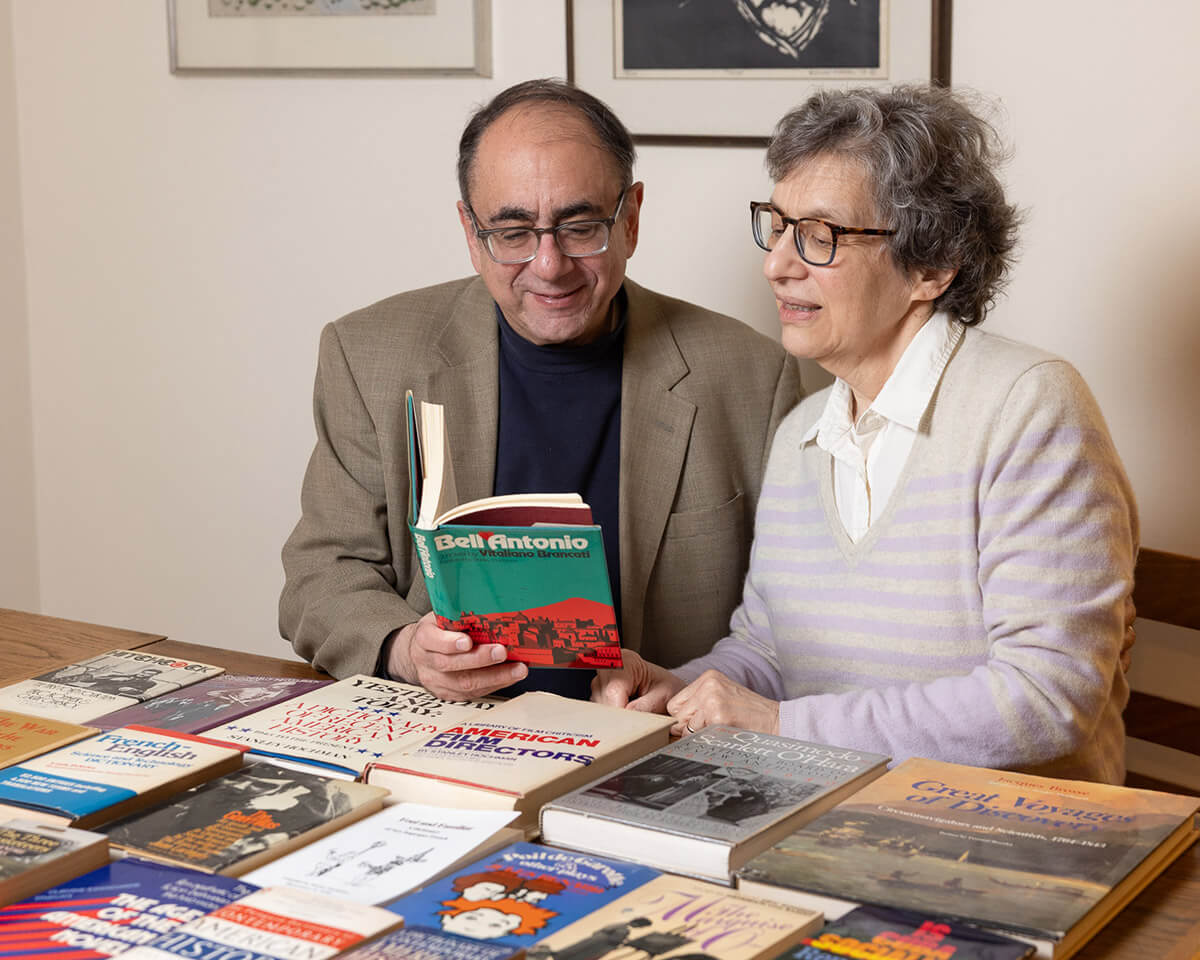
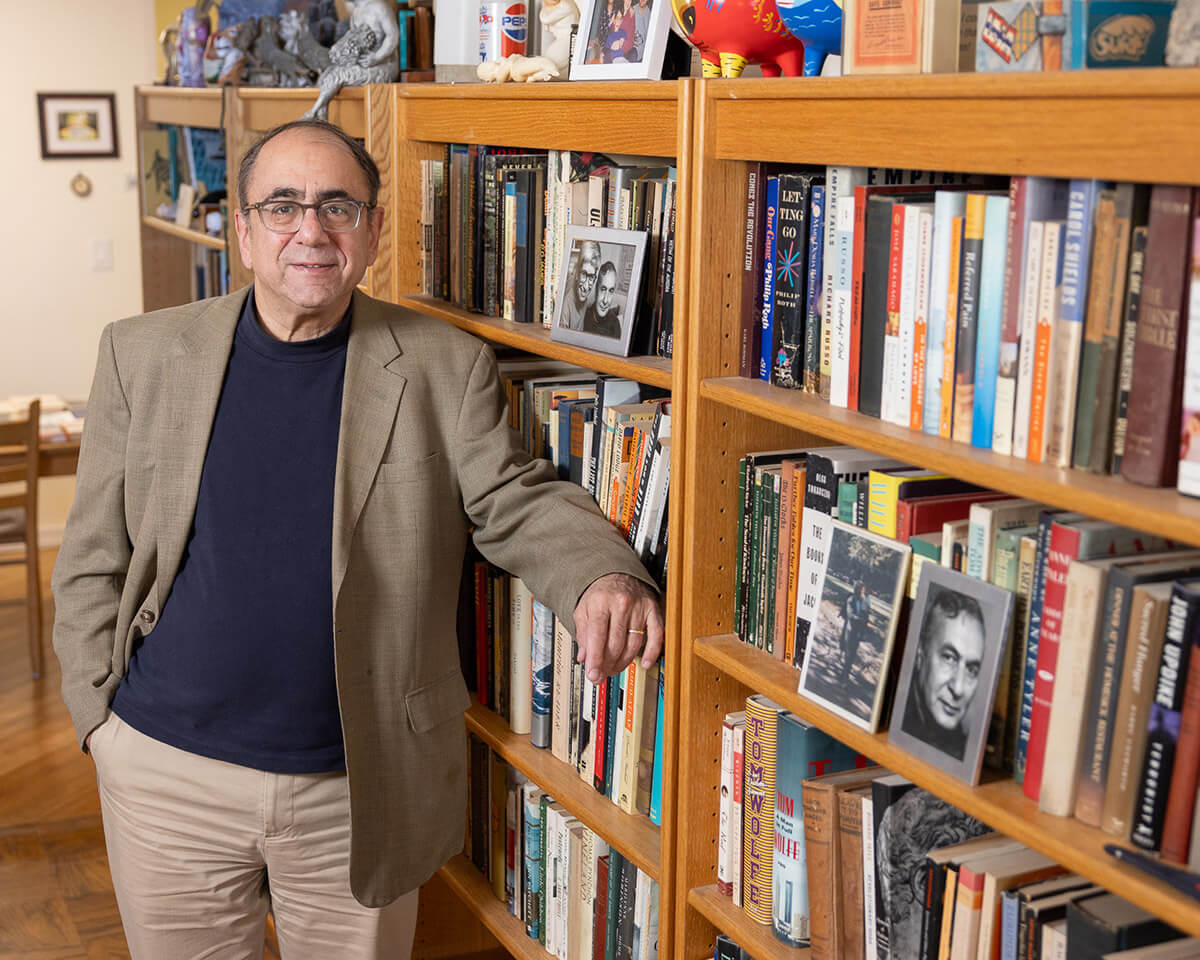
David Hochman and Genie Siegler at home, with a selection of Lee and Stanley Hochman’s published works.
“There Will Never Be Enough”
“My parents were humanities people,” says David. “I think they would have understood that there’s always going to be government support for research in the sciences—that’s the way it has worked in our society since World War II—but the humanities and social sciences will always scrap for support. There will never be enough.”
That lack of a sufficient funding framework for the humanities and social sciences was an impetus not just for the gift as a whole, but for the two separate funds—one designated for tuition support and the other for supplementary (but essential) student experiences.
This kind of a boost makes a big difference to students.
“The Hochman family gift will enable us to offer greater access to scholarships and awards and make possible meaningful opportunities such as research, travel, and other real-world experiences that extend learning well beyond the classroom,” says Philip F. Napoli, dean of the School of Humanities and Social Sciences. “We are touched that Mr. Hochman’s family made this contribution in honor of his parents.”
From Idea to Reality
While David Hochman describes himself as “mostly retired” now, his career has given him particular insight into the mechanics, and requirements, of higher education.
He spent decades working at the intersection of academic science research and regional job creation—including at the New Jersey Commission on Science and Technology and as a consultant in technology-based economic development. His work experience, he says, has brought him “into contact with a lot of universities and with a lot of faculty—and I have a good sense of how institutions work, what they need, what they don’t get, and so on.”
So how exactly did he come to the decision to establish these funds for Brooklyn College students?
“My dad died in 2014 and my mom in 2018, so all during COVID I was in the process of settling their estates and dealing with their belongings,” says David. “And as anybody who’s lost their parents knows, it takes time to process everything—not just the emotions, but the physical stuff.”
As he looked through his parents’ papers, he discovered “memorabilia that they had kept.” Things like high school newspapers, high school yearbooks—and Brooklyn College transcripts.
“I began thinking about those transcripts and thinking about what I could do,” says David. “And that’s really how [the gift to Brooklyn College] came about.”
Lee and Stanley Hochman had created a financial aid fund at their son’s preparatory school in honor of his grandparents, and with that gift in mind, David realized “there was nothing that honored my parents under their names.”
His next thought was “Well, if I wanted to honor my parents by name with a similar financial aid fund, what would be the right place to do it? And Brooklyn College is the right place to do it.”
By honoring his parents in this way, David has ensured that the curiosity, discipline, and love of learning that shaped his parents’ lives will continue shaping the lives of future Brooklyn College students. What began as a chance encounter on an ocean liner has become a legacy that will ripple outward for years. Through this gift, Lee and Stanley Hochman’s story now arcs into others: students who will dream bigger, travel farther, and discover more because of the doors the Hochmans have helped to open.