Whether it’s going out on an emergency call, training a student on how to drive an ambulance, or giving career advice, for Fred Kneitel there are no idle moments.
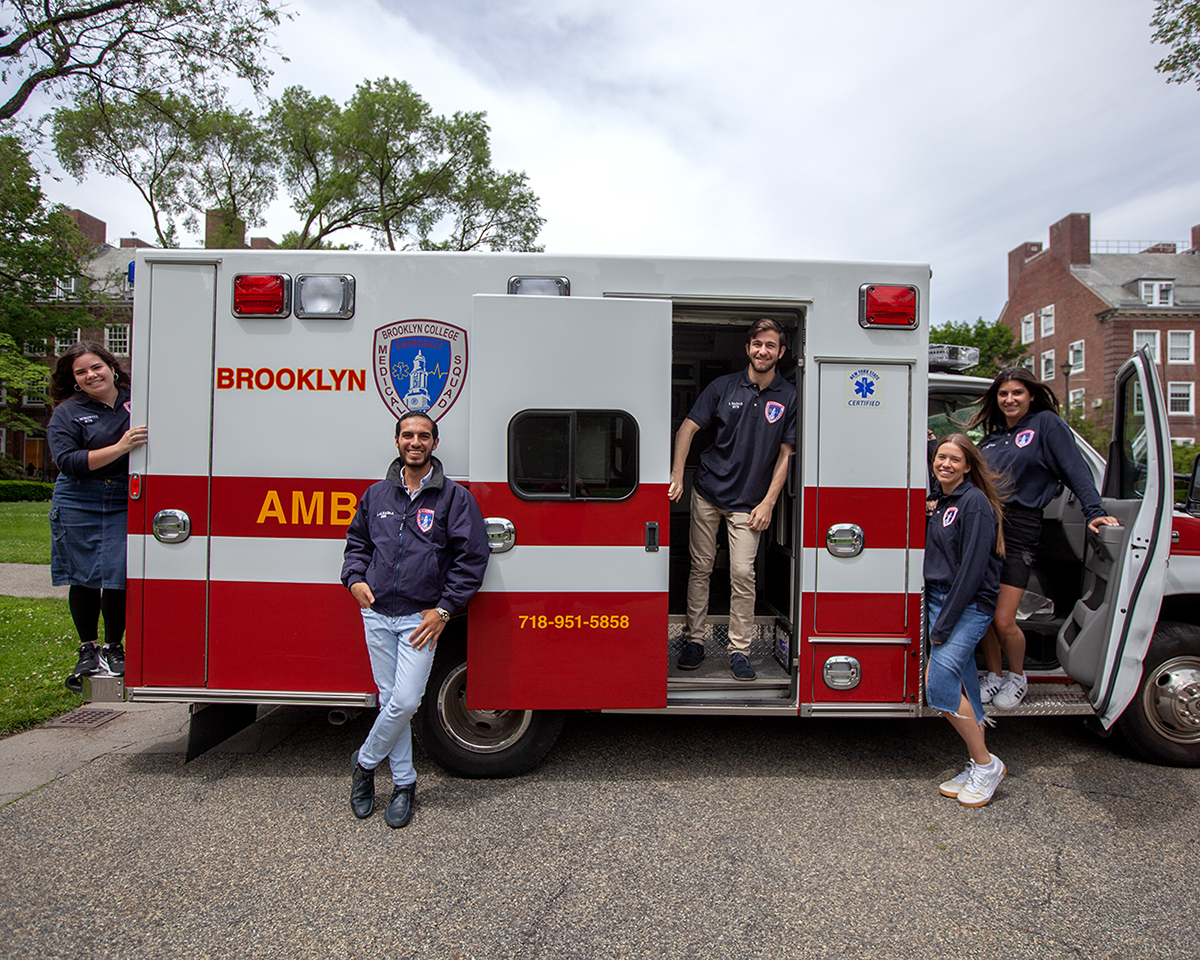
Kneitel has been involved with the Brooklyn College Emergency Medical Squad (BC-EMS) since he was a student, now serving as its administrative director. Established in 1977, the student-staffed BC-EMS provides experiential learning and basic life support services for the college campus. It also works closely with the college’s public safety office, student government, and a faculty adviser to ensure an effective response to emergencies.
Kneitel, who oversees the squad’s day-to-day operations and the training of student volunteers, takes great joy in the lasting impact of the program. Here, he talks about the day he stumbled into his lifetime vocation and the delight of seeing former students move on to careers in health care.
What inspired you to enter emergency services?
It all began in college. I grew up in Sheepshead Bay and went to private school through high school. My parents, especially my dad, were insistent on higher education. My mom was a stay-at-home mom, and my dad worked at least 13 to 15 hours a day. Being immigrants, they didn’t know much about the next steps, so I asked my friends where they were going, and they told me Brooklyn College.
During freshman orientation, I met a friend who was a couple of years ahead of me, and when I asked him what he was involved in, he mentioned BC-EMS. One day, I stopped by his office to ask him a question and was recruited on the spot. I started as a dispatcher and then took a first aid and safety class, which is still offered on campus. From there I eventually trained to be licensed as an EMT-paramedic
And you worked your way up to administrative director?
I was teaching in an emergency medical technician program for adult education off campus, and some of my students were from Brooklyn College. They found out that I was an alumnus who had been a member of the EMS club and asked if I wanted to be an administrative director. I accepted the position, and I’ve been in the position since the mid-1980s. I work in tandem with Computer and Information Science Professor Yedidyah Langsam, a faculty adviser to the students and also a certified EMT-paramedic
How does the EMS club on campus work?
We’re student-staffed, with pre-med and pre-health majors, as well as those majoring in other subjects, such as English, who just want to help.
As to services, we are licensed for basic life support such as CPR, assessment, airway management, bleeding control, and oxygen delivery until advanced medical help arrives or we transport the patient to an ER.
Can students start working right away when they volunteer?
They first train as dispatchers. If a student wants to do more, they learn first aid. I also teach them how to drive the ambulance. We’ll notice certain people as having the talent or showing a desire to become EMTs, and we will support them. I’ll tell them that if they want to come see me, then I’ll point them in the right direction. Ultimately, volunteering on the squad provides experiential learning, and the difference between sitting in class and experiencing real-life situations is significant.
So you’re an instructor and an adviser.
And a mentor. I tell my students that I’m not your parent, but if I ever find out you are not doing what you’re supposed to be doing, not as a squad member but academically, I’m not going to be happy. I have a responsibility to the administration and your parents, but especially to you.
You clearly love what you do, having been with the Brooklyn College EMS for decades.
Yes, I do. And over those years, two things are the same: my passion for teaching and mentoring, and that every day is different. Every month is different. There are months where we get few to no calls, and that’s fine.
Part of my job is to make sure that the students stay current in their skills. If there are no calls for that month, I become creative and make up a training call. The squad members won’t know it’s a training call until they show up. So, on the way, their adrenaline is pumping, and they’re supposed to be thinking about a plan and have it ready. What do I need to do? Hopefully, that’s what they’re doing. I like to drill that fact through them. You shouldn’t just be sitting there and then show up on the scene and then start pondering over it.
How large of a geographic area does Brooklyn College EMS cover?
The New York State Department of Health Bureau of Emergency Medical Services sets specific geographic areas for volunteer ambulance response. For instance, if someone on East 26th Street in the third house off Campus Road calls EMS, we can legally respond because that is within our geographic area. However, people typically call 911 instead of our 10-digit phone number for help. We are not open 24/7; we operate during campus hours.
And really, my students are students first and volunteers second. That’s the mantra that I always drill into them. Yes, it’s about the experiential learning, but you are a student first. So I would be on edge if they’re going into a private house or an apartment building—anything could happen. Now, if we’re driving back from a hospital and somebody jumps out in the middle of the road and says, “Hey, we need an ambulance,” then okay, yes, we can take care of the patient. But we generally stay within the Brooklyn College community, which extends from Ocean Avenue to Nostrand Avenue and from Campus Road to Avenue I. We are contacted and get moving once 911 is called for a campus emergency.
Do student volunteers go into medical careers?
I occasionally run into former students in various medical fields. For example, I was recently visiting my dad in the hospital when a woman visiting her mother in the next bed came out from behind the curtain and said, “You don’t remember me?” I did remember her! We spoke for a bit, and I met her mother, who told me, that because of me and this program, her daughter realized she wanted to be a doctor. It felt like a full-circle moment.
My greatest joy is seeing students succeed in their careers. I always tell my students that it’s not my work; I’m just the facilitator. It’s their work that got them where they are.