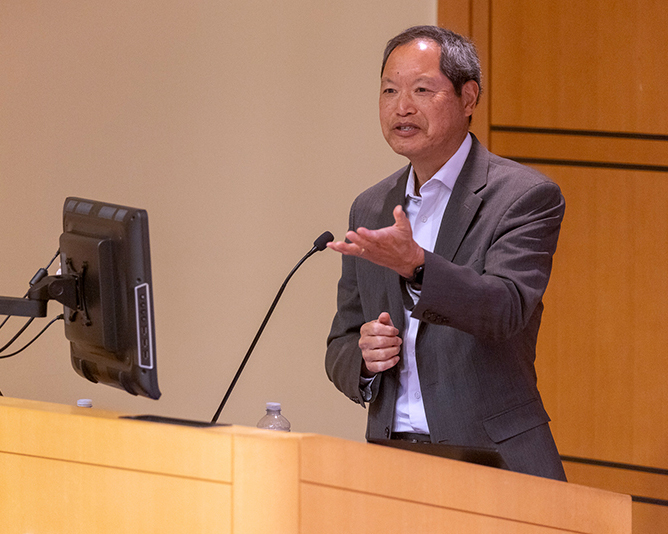
Brooklyn College welcomed students, faculty, and community members for Hess Week 2026, a three-day series of public events that explored Asian American lives, rights, civil liberties, faith, storytelling, mental health, and movements for racial justice. At the heart of this year’s program was the 2025–26 Robert L. Hess Scholar-in-Residence, Professor Russell M. Jeung of San Francisco State University, a sociologist, activist, and co‑founder of Stop AAPI Hate whose scholarship has shaped national conversations on race, religion, and justice.
A Week Framed by Scholarship, Community, and Social Transformation
Hess Week opened on March 17 with a Welcome Ceremony honoring Jeung’s residency. Joined by leading scholars Carolyn Chen, Jerry Park, and David Kim, the event highlighted the importance of research that bridges academic inquiry with community engagement and social change. Speakers reflected on the role of scholarship in confronting racial inequities and building coalitions across diverse communities.
That afternoon, the panel “The Lives, Rights, and Civil Liberties of Asian Americans in an Age of Mass Deportation” brought together experts in law, faith-based organizing, and advocacy to examine how contemporary immigration policies are reshaping Asian American communities. Panelists discussed tthe human impact of deportation, the rise of cross-racial solidarities, and the urgent need for policy reform that centers dignity and family unity‑.
Faith, Storytelling, and Healing
Events on March 18 turned toward the intersections of belief, belonging, and personal narrative. The morning panel, “Belief and Belonging: Faith Communities and Justice,” explored how religious communities have become vital spaces of resistance and refuge for immigrants navigating systems of exclusion. Speakers explored the wide variety of faith traditions that exist across Asian American communities and generations and how those traditions influence community and political participation. They also emphasized the role of inter-faith-based‑ networks in sustaining movements for human rights.
In the afternoon, memoirist Ava Chin, author of the bestselling Mott Street and CUNY faculty, joined Jeung for “Recuperating Collective Stories: Writing Chinese American Memoirs.” Together, they reflected on memory, migration, and the power of storytelling to reclaim histories that have been marginalized or erased. Their conversation illuminated how personal narratives can bridge generations and reshape public understanding of Asian American experiences.
The day concluded with “Struggling, Surviving, Thriving—Asian American Mental Health,” a timely discussion featuring scholars and clinicians including Clarissa S.L. Cheah and Cindy Liu. The panel addressed the socioemotional challenges facing Asian American adolescents and college students, especially after the increase in anti-AAPI hate crimes in 2020, ‑underscoring the need for culturally responsive mental-health support and community-based care. Brooklyn College Psychology Professor Erika Niwa ended the event by asking the audience to remember that “we belong to each othe‑r.”
A Vision for Justice: The 2026 Hess Memorial Lecture
The week culminated on March 19 with the 2026 Robert L. Hess Memorial Lecture, “Asian American Movements for Racial Justice: Resistance and Solidarity,” delivered by Jeung. The Tanger Auditorium was filled to capacity to hear him explore the lessons we can draw from late-19th century Chinese American civil disobedience campaigns and legal challenges to anti-immigration laws. Jeung invited the audience to imagine new possibilities for justice grounded in solidarity, resilience, and collective action.
A Collective Story of Community and Care
Across its three days, Hess Week 2026 offered a powerful narrative: of communities confronting pressure and exclusion, of faith and culture as sources of belonging, of storytelling as resistance, of mental health as a matter of justice, and of movements that insist on dignity for all. The series reaffirmed Brooklyn College’s commitment to fostering dialogue, scholarship, and community engagement around the most pressing issues of our time.
All events were free and open to the public, continuing the tradition of making Hess Week a space for shared learning, care, and solidarity.
Recordings of the Hess week are available here.