
Brooklyn College is advancing its leadership in artificial intelligence education with a series of newly funded initiatives supported by the City University of New York (CUNY).
Spanning disciplines from business and computer science to the arts and education, the projects reflect a campus-wide commitment to preparing students for a rapidly evolving, AI-driven world. Funded initiatives extend across the Koppelman School of Business as well as programs in English, film, art, mathematics, education, academic affairs, and Student Affairs.
Integrating AI Into Business Education
Several faculty from the Koppelman School of Business are launching an interdisciplinary capstone course titled “The Integrated Edge: AI, Decision-Making, and Business Strategy.” The course will pilot in summer 2026.
The course addresses a long-standing challenge in business education: the “silo effect,” in which accounting, finance, economics, and management are often taught separately. The Integrated Edge instead requires students to apply all four disciplines simultaneously to analyze complex business problems—mirroring how decisions are made in real organizations.
Students will gain hands-on experience with professional AI platforms used in industry, including tools for forecasting, auditing, and financial analysis. The course also emphasizes a “human-in-the-loop” approach, teaching students to critically evaluate AI-generated outputs, identify potential biases or errors, and apply professional judgment.
Structured in four modules—economic forecasting, led by Professor Merih Uctum; AI-assisted auditing, led by Professor Frimette Kass-Shraibman; corporate finance, led by Professor Sunil Mohanty; and strategic integration, led by PI and Professor Carol Connell—the course culminates in a capstone project in which students analyze a real company using both traditional business frameworks and AI-supported insights.
By combining interdisciplinary thinking with responsible AI use, The Integrated Edge aims to equip students with the analytical, technological, and ethical skills needed for tomorrow’s business leadership.
Koppelman School of Business Interim Dean Myles Bassell is leading nearly 400 students from the Koppelman School of Business in “IBM’s AI Experiential Learning Lab,” a hands-on, 10-week program designed to immerse students in real-world artificial intelligence applications. Through the program, students work in multidisciplinary teams to design and develop AI-driven solutions using IBM’s enterprise technologies, including watsonx. Supported by IBM experts and industry mentors, students move from concept to prototype while tackling authentic business challenges.
Throughout the lab, participants build practical skills in generative and agentic AI, as well as responsible AI design, while producing portfolio-ready projects that enhance their career readiness. By the program’s conclusion, students will have completed AI solutions they can present to employers and will earn IBM-recognized digital credentials to showcase on LinkedIn and resumes. The initiative reflects Koppelman’s commitment to experiential learning, industry collaboration, and preparing students to lead in an AI-driven economy.
Bassell is also spearheading the broader “AI Literacy in Business Education: From Classrooms to Careers” initiative, which is being implemented in phases beginning in Fall 2025 and continuing through Spring 2026, with expansion planned for Summer 2026 and beyond. In Fall 2025 alone, Koppelman students completed approximately 700 IBM AI-related certificates, followed by more than 1,000 additional certifications in Spring 2026. These credentials were integrated directly into coursework through collaboration between Bassell and business school faculty.
Students earn certifications through IBM SkillsBuild in areas such as AI Literacy, Artificial Intelligence Fundamentals, Generative AI, Agentic AI applications, Enterprise Design Thinking, and Cybersecurity Fundamentals, among others. Each certification includes a verifiable digital badge, allowing students to clearly demonstrate their AI competencies to prospective employers.
Management, Marketing and Entrepreneurship Associate Professor Ngoc (Cindy) Pham is leading the “CUNY AI Literacy and Professional Readiness Micro-Credential Series With Global Expert Partners.”The semester-long weekly boot camp is designed to build applied and ethical AI fluency while preparing students for the evolving workforce.
The initiative combines hands-on workshops, industry perspectives, cross-institution collaboration, and digital badge recognition to help students develop both technical confidence and critical thinking skills.
Program highlights include weekly AI boot camps at Brooklyn College, guest speakers and industry experts from IBM and other national AI practitioners, and a joint CUNY–NYU Tandon session hosted at NYU that helped launch a long-term collaboration. Students also take on leadership roles as moderators and event facilitators. Designed for scalability, the model aims to expand across CUNY while maintaining a strong focus on equity, access, and workforce readiness.
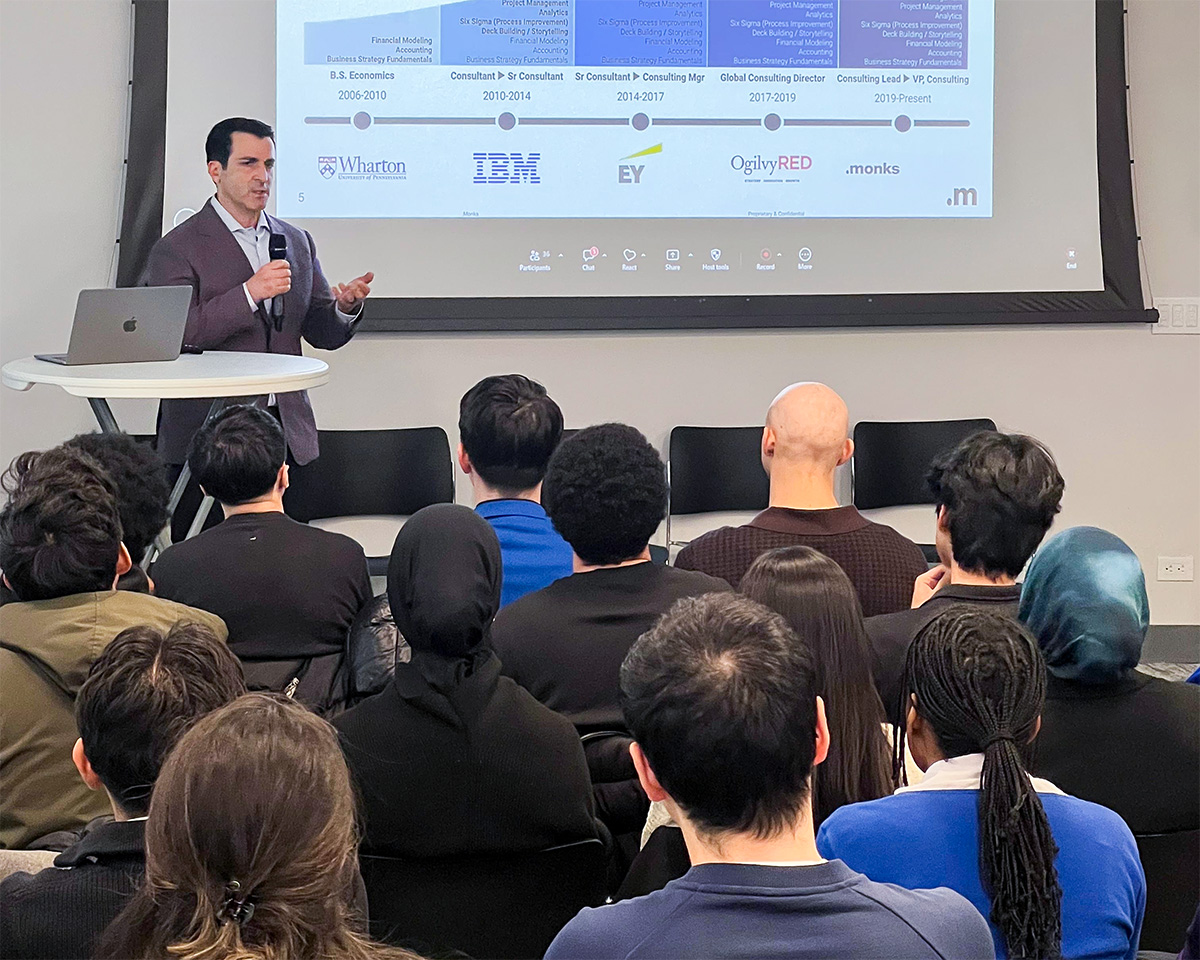
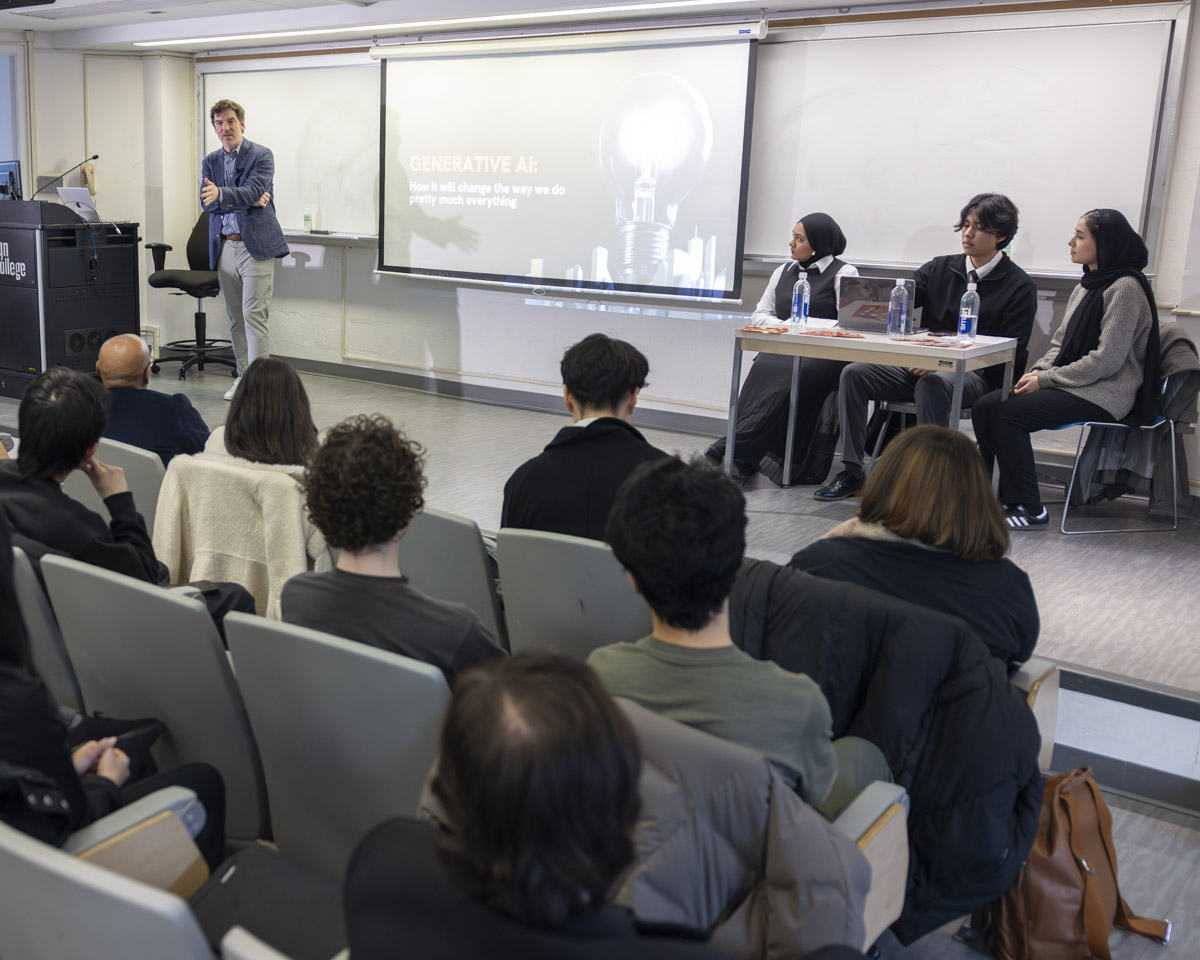
Matt Lentz, vice president at Monks and founder of the Enterprise Consulting Practice, speaks at an AI bootcamp hosted by NYU’s Tandon School of Engineering on March 12. The event was a part of the CUNY AI literacy and professional readiness series led by Brooklyn College Associate Professor Ngoc (Cindy) Pham and focused on AI in enterprise consulting. (Top photo) In February, guest lecturer Conor Grennan—CEO of AI Mindset and New York Times bestselling author—headlined a lecture titled, “Artificial Intelligence & the Future of Work” that drew 118 participants.
Expanding AI to Student Support: Addressing Food Insecurity
Brooklyn College’s AI initiatives also extend beyond the classroom, applying emerging technologies to one of the most pressing challenges facing students: food insecurity.
Led by Associate Professor of Management, Marketing and Entrepreneurship Laura Rifkin and building on the human-centered work of the campus food pantry staff—including Assistant Director of Student Support Services Nicole Cohen and Student Affairs—this effort will explore how AI can expand access to nutritious food in ways that are both practical and dignified. One approach under consideration is a smart vending system that would serve as an extension of the pantry, offering discreet, flexible access outside of traditional hours. By reducing barriers such as stigma, scheduling conflicts, and transportation challenges, the system could significantly broaden its reach while generating anonymized, real-time data on usage patterns and unmet need.
The initiative also examines how agentic AI can support pantry operations behind the scenes—analyzing trends, anticipating demand, optimizing inventory, and improving coordination of donations and purchasing. Guided by principles of transparency, human oversight, and bias mitigation, the work builds on the college’s strong track record of student-centered support while introducing scalable, data-informed solutions.
The effort comes at a critical moment. Food pantry use has grown fourfold in recent years, reflecting both rising need and the extraordinary commitment of staff working with limited resources. Across CUNY, approximately 110,000 students—about 40% of the system—experience food insecurity, yet only a small percentage access available support, often due to stigma or administrative barriers. By integrating AI thoughtfully into these services, the college aims to close that gap by strengthening student well-being to support academic success.
AI-Supported Professional Preparation for Early Childhood Teachers Working With Dual Language Learners
In the School of Education, Associate Professor Lulu Song is addressing a critical need in early childhood teacher preparation. Her project integrates AI into coursework to support future educators working with dual language learners, a population that represents nearly half of young children in New York State. Through structured assignments, students will use AI tools for research and problem-solving while learning to critically evaluate outputs for accuracy, bias, and credibility.
Additional projects include AI-supported learning studios in mathematics, interdisciplinary minors linking computer science with writing and finance, and research on ethical design and decision-making. Collectively, these initiatives highlight Brooklyn College’s holistic approach to AI—one that blends innovation with responsibility, and technical skills with human insight.
Understanding AI: A Foundational Series for Faculty
Led by Karen Stern-Gabbay, professor of history and director of the Roberta S. Matthews Center for Teaching and Learning, and James T. Eaton, associate dean in the Provost’s Office, this workshop series will bring expert speakers to campus to guide faculty through key topics such as technological disruption, ethics, and curriculum design.
Open to both full- and part-time instructors, the program is designed to build confidence and shared understanding around AI in the classroom.
Faking It: A Global Workshop Series
AI’s cultural and creative implications are also a focus. Distinguished Professor of Film Alexandra Juhasz, in collaboration with filmmaker Nishant Shah, is leading “Faking It,” a global workshop series examining questions of authenticity, knowledge, and human connection in an AI-mediated world. With sessions planned in New York and Hong Kong, the project will explore how emerging technologies reshape storytelling, perception, and social relationships.
You can see all the projects listed here.
- Myles Bassell (Management, Marketing, and Entrepreneurship) – AI Literacy in Business Education: Scaling a Proven Model at the Koppelman School of Business.
- April Bedford (Academic Affairs) – Faculty AI Bootcamp: Developing Critical AI Literacy, Course Policies, and Pedagogical Innovation.
- Hui Chen (Computer and Information Science) – Human-in-the-Loop Just-in-Time AI Auto-Tutoring: A Pilot for CUNY Pathways Courses.
- Carol Connell (Management, Marketing, and Entrepreneurship) – AI, Decision-Making, and Business Strategy Integrated Capstone.
- James Eaton (Academic Affairs) – Understanding AI: A Foundational Series for Faculty.
- Alexandra Juhasz (Film) – Faking It: AI Education and Literacy.
- Devorah Kletenik – (Computer and Information Science) Designing With Ethics: Exploring AI-Enhanced Dark Patterns.
- Swan Kim (English) – Critical AI Literacy for the Public Good: A CUNY-Scalable Ethical Foundations Module Reaching All Incoming Students.
- Sandra Kingan (Mathematics) – AI-Supported Math Foundations Studio.
- Anjali Krishnan (Psychology) – Promoting Responsible AI Use in Skill-Based and Writing-Intensive Courses.
- Jennifer McCoy; Jonathan Zalben (Art, Conservatory of Music) – AI Initiative in the Arts.
- Martha Nadell and Hui Chen (English, Computer and Information Science) – Writing For the Future: An Integrated English/Computer and Information Sciences Minor.
- Hyuna Park and Katherine Chuang (Finance, Computer and Information Science) – Using AI Tools to Create Synergy Between Finance and Computer Science Education.
- Ngoc (Cindy) Pham (Management, Marketing, and Entrepreneurship) – CUNY AI Literacy and Professional Readiness Micro-Credential Series With Global Expert Partners.
- Laura Rifkin (Management, Marketing, and Entrepreneurship) – Addressing Food Insecurities.
- Lulu Song (Early Childhood Education/Art Education) – AI-Supported Professional Preparation for Early Childhood Teachers Working With Dual Language Learners.