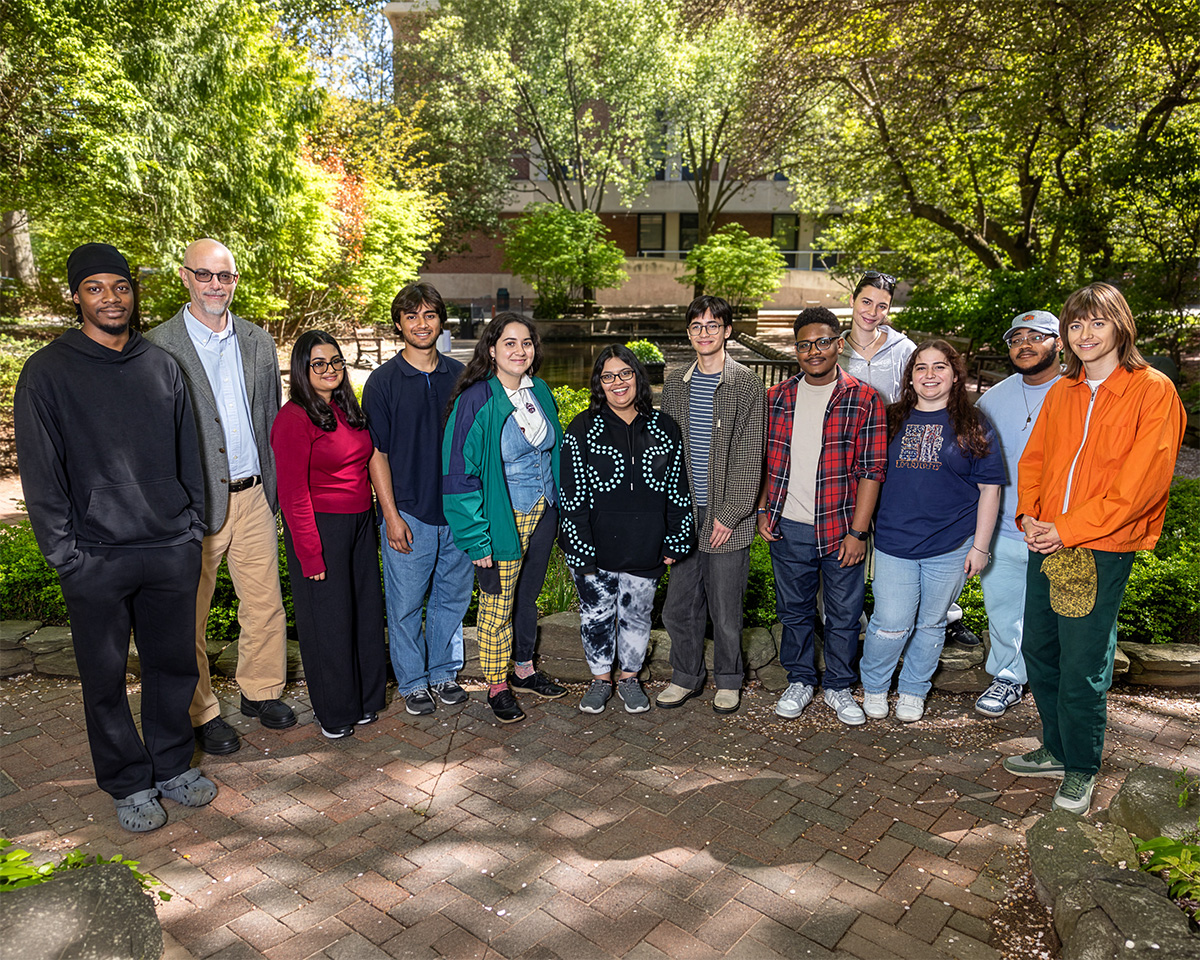
Michael Menser (second from left) with students from his environmental ethics class.
On a spring morning in 2025, students in Brooklyn College’s Urban Sustainability Capstone course fanned out across campus with measuring tapes, field guides, and tablets in hand. Their assignment posed a deceptively simple question: How healthy are the trees on Brooklyn College’s campus?
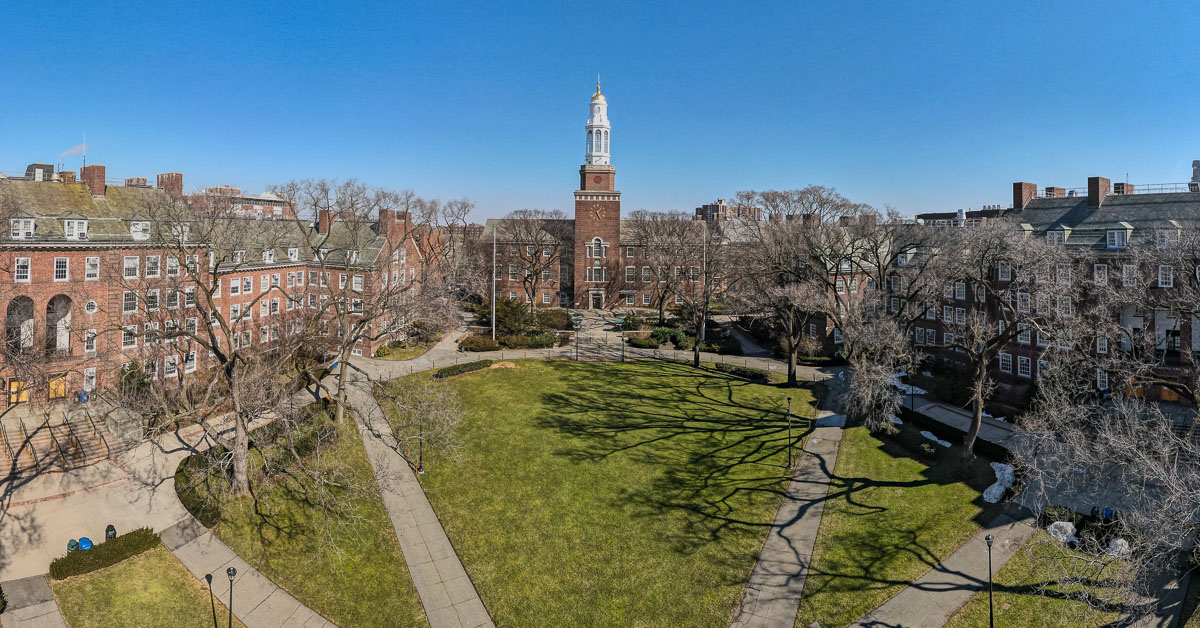
The answer, it turns out, is more than an inventory of trunks and canopies. What emerged was a living portrait of the campus itself—its past, present, and future, captured through student research that bridges environmental science, campus history, and public service in the heart of New York City.
Partnering with the NYC Parks Foundation, Capstone students designed and carried out a comprehensive tree-mapping initiative, inventorying and digitally documenting the campus’s diverse urban forest. Along the way, they gained hands-on experience identifying tree species, assessing tree health, and using geographic information systems (GIS) to collect and manage ecological data—practical skills aligned with careers in urban planning, sustainability, and environmental science.
But the project’s significance extends far beyond the classroom.
Contributing to a Greener City
The tree-mapping initiative connects Brooklyn College to Forest for All NYC, a citywide effort to expand New York City’s tree canopy from roughly 20% to 30%, with particular focus on neighborhoods that have historically lacked green infrastructure.
While the city regularly surveys trees on municipal property, CUNY campuses are not considered city-owned and are therefore excluded from official canopy inventories.
Brooklyn College’s size, location, and ecological diversity created a rare opportunity to help fill that gap.
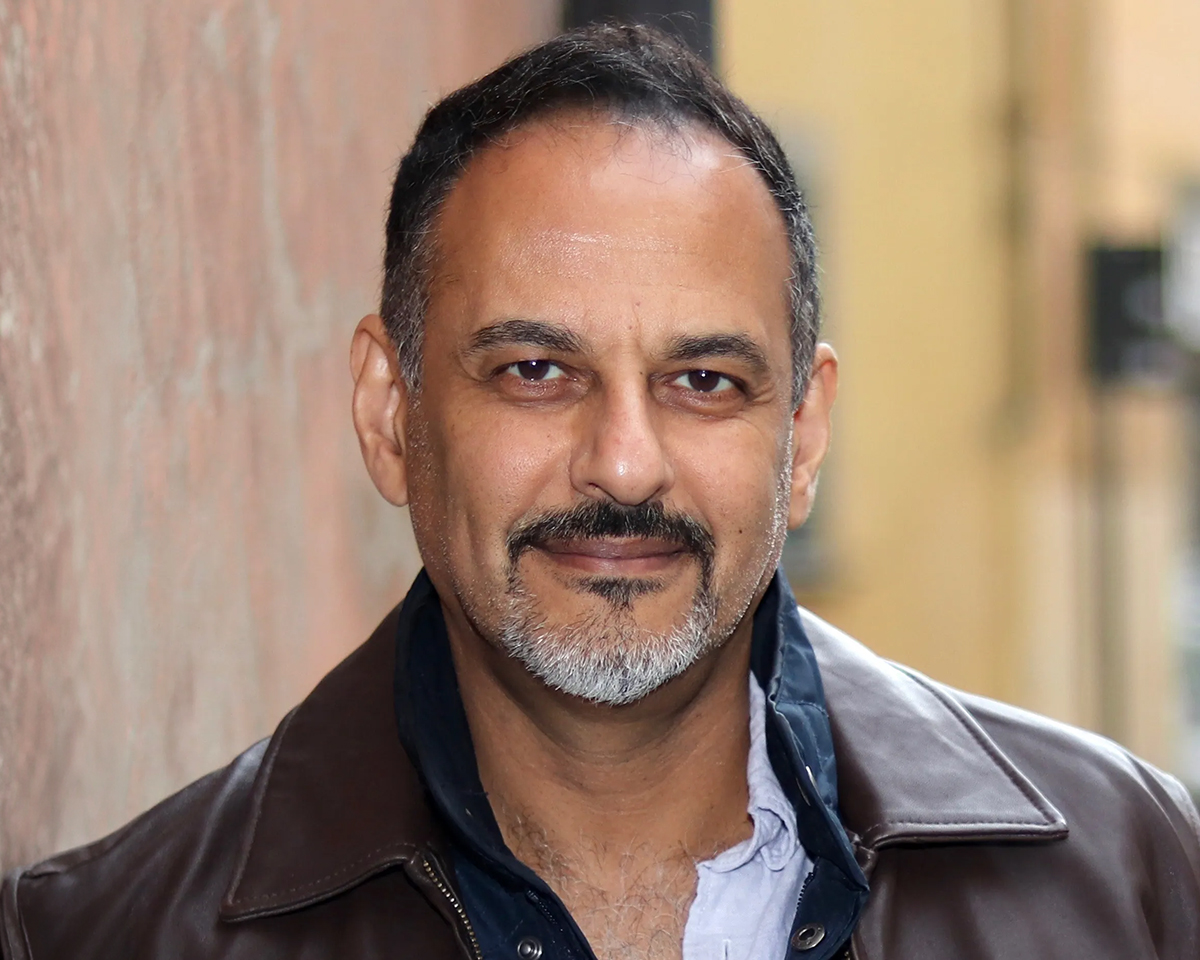
“With this project, students are generating data that didn’t exist before,” said Michael Menser, associate professor of philosophy and one of the faculty leaders of the initiative. “They’re contributing real information that can influence how we think about urban forests—both on campus and beyond.”
Rooted in Campus History
As students moved across the campus and quiet garden paths, their research also took them decades, sometimes nearly a century, into the past.
The land on which Brooklyn College sits was founded as an arboretum, with its original landscape intentionally designed to integrate nature into academic life. In the 1930s, a greenhouse located behind Ingersoll Hall near Campus Road served as a botanical hub for students and faculty until it was later demolished during campus expansion.
As part of the Capstone, students conducted archival research into this landscape’s history, uncovering original arboretum-era tree lists alongside inventories and maps created over the past 30 years. The material revealed how the campus grounds have evolved in step with the surrounding Flatbush neighborhood.
“The trees tell a story,” Menser said. “They reflect planning decisions, social changes, and what a public urban campus has valued over time.”
228 Trees—and Counting
To date, students have identified, assessed, and mapped 228 trees across the campus. The inventory ranges from stately Siberian elms on the Quad, to cherry trees lining the back of the library, to a rare dawn redwood growing beside the koi pond.
Each tree was documented with species data, precise location, and health indicators, creating a foundation for long-term campus planning and care.
Informing the East Quad Renovation
The timing of the project is especially significant as Brooklyn College moves forward with a major renovation of the historic East Quad, one of the most iconic and heavily used spaces on campus.
The renovation aims to create a safer, healthier, and more sustainable landscape while preserving the Quad’s historic character. Plans include replacing aging or hazardous trees with disease-resistant plantings, repairing underground infrastructure, improving stormwater management, and modernizing lighting and electrical systems.
Student-collected data provides valuable context for this effort—connecting archival history, present-day conditions, and long-term environmental goals. Together, the renovation and the tree inventory reflect a shared commitment to stewardship and resilience.
Sustainability Across Disciplines
The tree-mapping project mirrors the college’s broader strength in interdisciplinary sustainability education. Across campus, students and faculty are engaged in hands-on initiatives linking environmental science, public health, infrastructure, and social impact.
“Brooklyn College is uniquely poised to lead in this space,” Menser noted. “We bring together health, soil science, urban ecology, social research, and community engagement in one place. Students don’t have to imagine what sustainable cities look like—they’re studying them and helping to build them here.”
Looking Ahead
The Urban Sustainability Capstone has positioned Brooklyn College as the first CUNY campus to create a comprehensive, GIS-based tree inventory, contributing valuable data to New York City’s evolving urban forest planning efforts.
Faculty are now working to connect additional courses to the initiative through the Campus as a Living Lab program, ensuring that the data continues to grow and inform future instruction, research, and campus decision-making.
At a time of climate change and environmental inequity, Brooklyn College’s trees—anchored in history, studied through student research, and renewed through strategic investment—stand as living proof of how urban public institutions can lead by example, one branch at a time.