Aleah N. Ranjitsingh
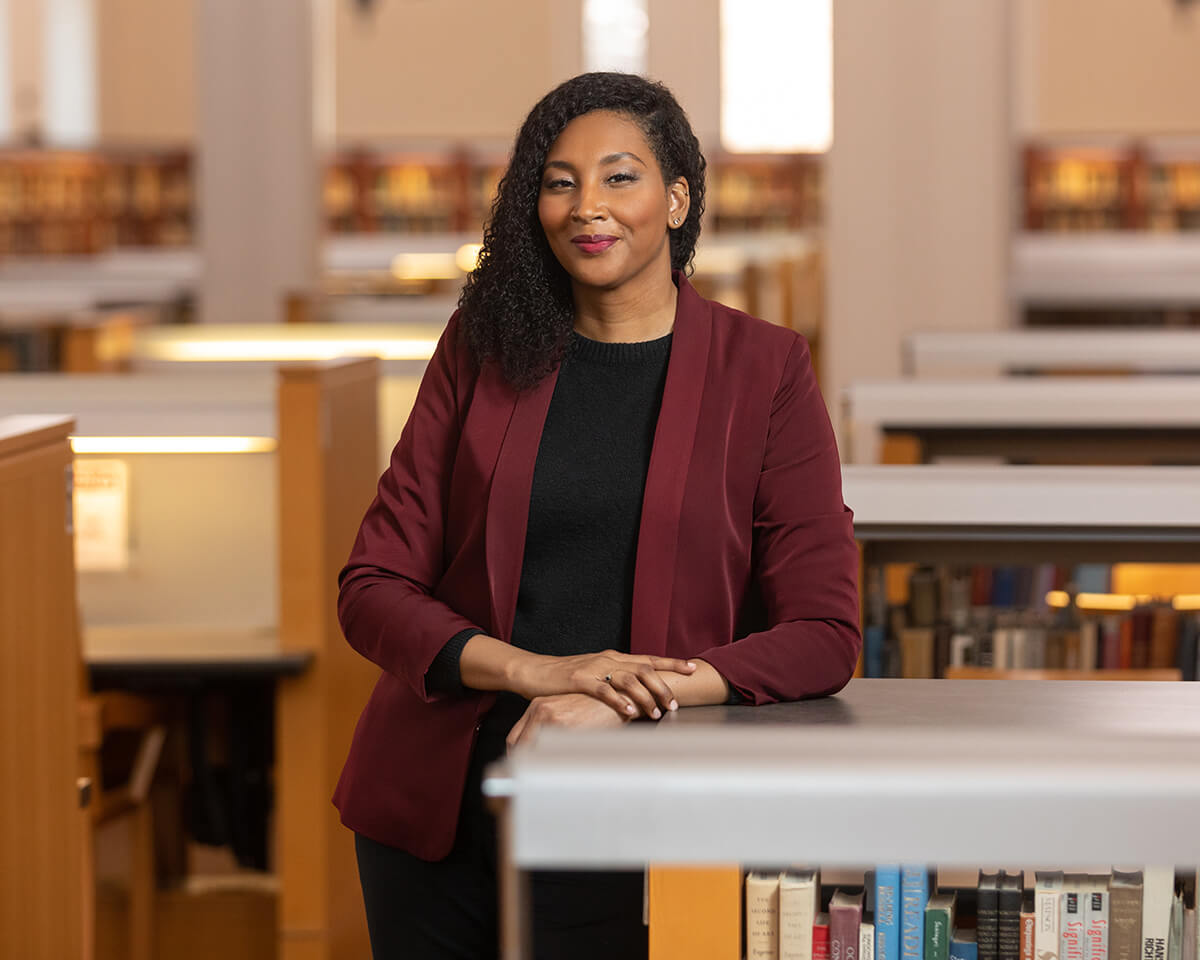
At Brooklyn College, Assistant Professor Aleah N. Ranjitsingh, Department of Africana Studies and the Caribbean Studies Program, is reshaping how we think about knowledge, identity, and the Caribbean itself.
A proud alumna of the college who earned a B.A. in political science and an M.A. in comparative politics, Ranjitsingh centers her scholarship on the Greater Caribbean as an epistemological space—one where Caribbean and other diverse populations are not merely subjects of study, but knowledge producers whose lived realities, family histories, and cultural practices are legitimate sites of inquiry. Across her inter- and multidisciplinary work, she challenges monolithic narratives of the Caribbean and foregrounds the complexity of identity formation, gender, mixedness, and racialization both “at home” and across the diaspora.
Through projects such as “Becoming Black: Afro-Caribbean and/in ‘Black America,’” “Dougla Lives: At the Intersections,” and “Chinese Caribbean Narratives: Migration, Identity, and Belonging at Home and Diaspora,” she documents how Caribbean peoples navigate race, belonging, and migration in shifting social contexts.
Just as vital to her work is mentorship. Through programs including the Tow Mentorship Initiative and Mellon Mays, as well as sustained independent study, Ranjitsingh positions students as knowledge producers in their own right, encouraging them to claim their intellectual lineage and recognize that what they think, know, and create truly matters.
How does working across disciplines allow you to tell fuller stories?
I am a political scientist and a gender scholar, but more importantly I am a Caribbean scholar. Caribbean studies is inherently interdisciplinary, and here at Brooklyn College, the Caribbean Studies Program, directed by Associate Professor Dale Byam, reflects this breadth—from classes on the steelpan, to climate justice, to Carnival, and much more. My own research is shaped by this interdisciplinarity, and it has deeply informed the oral history projects I undertake.
Oral history is about the stories of those whose voices are often marginalized; it is about memory, and how the same moment can be remembered differently depending on one’s lived experience.
In my first oral history project, “Becoming Black: Afro-Caribbean and/in ‘Black America,’” which centers Afro-Caribbean immigrants in New York City, I was interested in how Afro-Caribbean immigrants re/construct identity as Black and/or African American. I was also deeply interested in how these immigrants understood the 2020 moment when Black Lives Matter protests erupted across the United States and globally. Understanding how people experience a shared historical moment—while also situating that moment within broader political histories—required me to move across disciplines, drawing from political science, Africana studies, and history.
Before my third project, on Caribbean people of Chinese and mixed-Chinese ancestry, I was reading Caribbean literature and history whenever I could—Kerry Young’s Pao and the work of historian Walton Look Lai. Literature and history both inform my oral history practice because I am interested in how Caribbean people write themselves into being, and how meaning is made through narrative.
I also draw heavily from institutional and intellectual communities. Professor Joseph Entin and colleagues who founded the Brooklyn College Listening Project have been central in shaping oral history work at the college. Likewise, Dean Philip Napoli, an oral historian and faculty member in the Department of History, met with me when I was first simply curious about doing oral histories. These mentors helped me understand that students’ stories matter—and that those stories are themselves knowledge.
Was there a moment when you realized lived experience could function as scholarship?
I do not think there was a single moment. Rather, over the last decade—especially after completing my Ph.D.—there was a gradual but clear shift in my research toward the personal and toward lived experience, including my own as a Black, Dougla, Caribbean woman in the Caribbean and New York City.
Even in my doctoral work on gender and the Bolivarian revolution in Venezuela, I conducted more than 70 interviews with women in Caracas and Mérida. I knew then that to understand whether participatory democracy and 21st century socialism had expanded citizenship and political agency, I had to speak directly with women themselves. That commitment reflects feminist standpoint theory, which holds that knowledge is socially situated and produced from multiple social locations.
Later, in conversations with colleagues at the University of the West Indies—particularly within the Institute for Gender and Development Studies—we began reflecting on mixedness and Douglaness in Trinidad and the diaspora. These conversations affirmed that our stories were not just personal reflections; they were also scholarly interventions. The Dougla identity—Caribbean people of African and Indian ancestry—became a central site of inquiry.
From those discussions, Sue Ann Barratt and I co-authored Dougla in the Twenty-First Century: Adding to the Mix (2021), based on interviews with more than 100 Douglas in Trinidad and Tobago and in New York. The project foregrounded lived experience as theory, showing how people narrate identity, race, and belonging in their own words.
From there, my work has continued to move in that direction: treating lived experience not as anecdote, but as method, archive, and scholarship.
How is mentorship part of your scholarship?
For students to believe that what they think, know, and create matters, I first had to believe that for myself. When I tell students to “have the audacity,” I am also reminding myself.
Mentorship, for me, is a form of radical care. It is about telling and showing students that their intellectual lives are valid—even when their projects do not fit neatly within disciplinary boundaries.
I think of students like Cynthia Leung, Katryna Alexis, Marisha Sampson, Maciel Rosario, and Brandon Abram, each of whom developed projects that emerged from their own lived realities: oral histories of church communities, Afro-Guyanese Kwe Kwe traditions, interrogating the displacement caused by foreign-owned mining companies in the Dominican Republic, explorations of mixedness and Black radical thought. In each case, my role was not to define the limits of their work, but to affirm that their questions were worth pursuing.
With Brandon Abram, for example, we developed a project that began with his desire to write about himself in relation to Blackness and identity. I introduced him to autoethnography as a method, and we read Zami: A New Spelling of My Name by Audre Lorde together. What began as uncertainty became a conference presentation and is now developing into a published duoethnography.
This is what mentorship looks like in practice: shared intellectual risk, collaborative reading, and mutual learning. Students are not simply recipients of knowledge—they are co-producers of it.
This philosophy is reflected institutionally as well. At Brooklyn College, I serve as chair of Black Faculty and Staff (BFS), where we launched the Sankofa Excellence Program to support student mentorship, recognition, and retention. Alongside the members of the executive board, which is composed of Assistant Professor Lawrence Johnson, Crystal Schloss-Allen, Sherome Stone, Assistant Professor Donna-Lee Granville, and the BFS community, we also continue traditions like the Donning of the Kente pre-graduation ceremony, which celebrates students as they approach graduation. I am also grateful for incredible faculty mentors such as my chair, Associate Professor Prudence Cumberbatch of the Africana Studies Department.
Mentorship is not separate from scholarship. It is scholarship—because it produces knowledge, relationships, and intellectual communities.
What do you hope students carry with them?
Long after students leave my classroom, I want them to remember that their lives are connected to broader histories and communities.
I want them to see critical thinking not as an abstract skill, but as a daily practice: questioning assumptions, reading widely, and reflecting honestly on their own experiences.
I hope they continue to “have the audacity” to take up space, to dream, and to speak—even when they are the only ones in the room with their particular voice, accent, or perspective.
In a world that is often unjust and uneven, I hope they choose kindness without losing intellectual rigor. Most of all, I hope they trust that their stories matter.
And I hope they remember Brooklyn College—not only as an institution, but as a place where they were supported, challenged, and cared for; a place where they belonged.