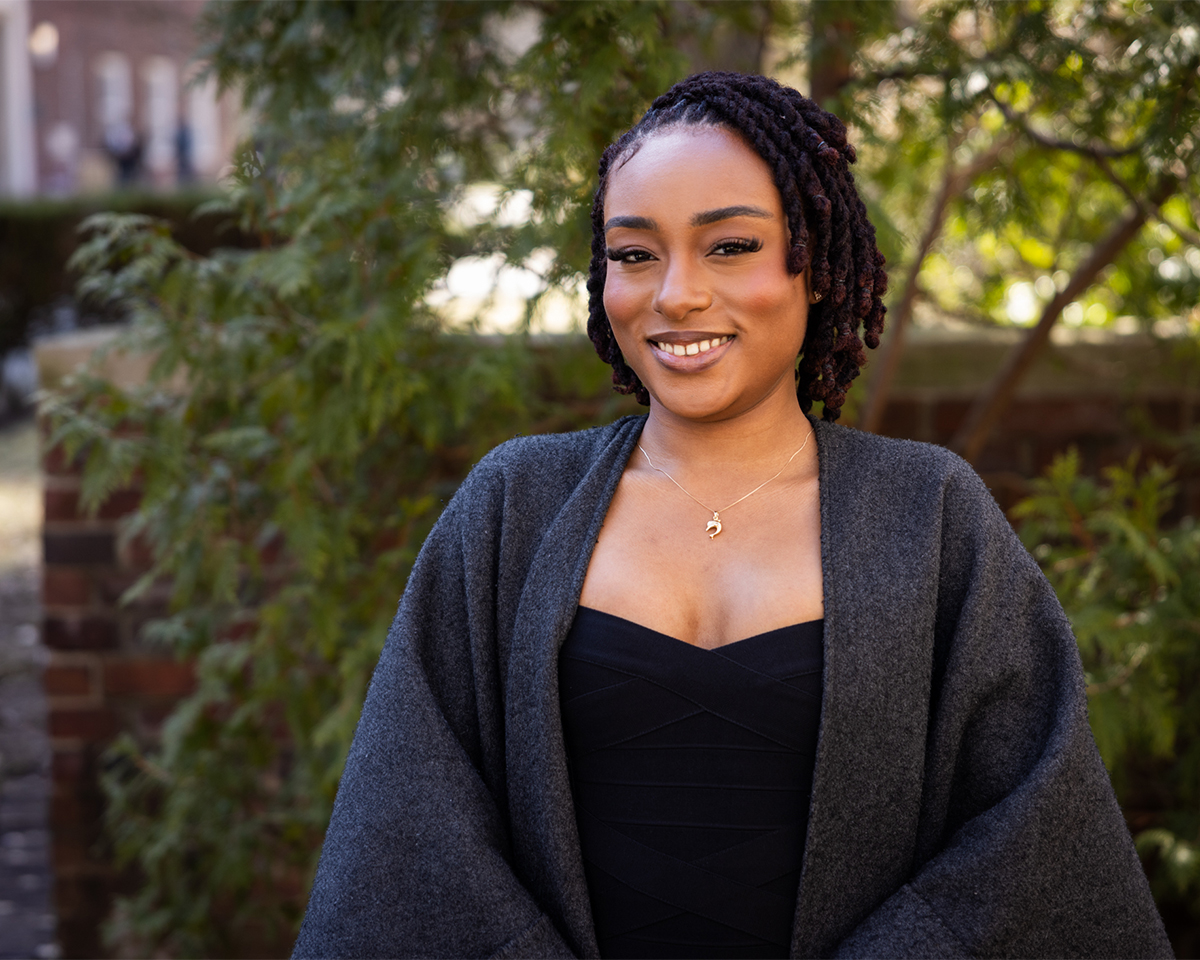
Hannah Chin-Phillips took a beat to look over her notes when she first approached the dais at the college’s annual Donning of the Kente Ceremony, a pre-Commencement celebration of Black graduates hosted by the Black Faculty and Staff Association, the Black Student Union, and BLMI.
“Take your time,” one her peers yelled from the audience.
If the pause betrayed any nervousness around giving the student address in front of the boisterous crowd in the Claire Tow Theater, it quickly gave way to a fiery speech that struck a chord with the assembled.
Adversity? “Seen it. Lived it. Felt it,” she said defiantly, after invoking Langston Hughes and recounting a childhood that taught her that life won’t always look like what you expected.
“Our accomplishments,” she told her fellow graduates, “live in every sacrifice, every setback, every reason we could have stopped, but didn’t.”
Chin-Phillips says she certainly had her share of challenges growing up between Brooklyn and Barbados. Born in the United States, her mother was deported when she was 6 years old, so she was raised mostly by aunts and other family members in New York while her mother stayed in Barbados.
As she prepares to apply for doctoral programs in occupational therapy, the transfer student talks about growing up apart from her nuclear family, learning that support would always show up when she needed it, and her gratitude for the community and mentors at Brooklyn College that reminded her of her worth.
What was your childhood like?
My family is from Barbados and Guyana, and I spent a lot of time going back and forth between the two places. Every summer, I was in Barbados almost immediately after school ended, and I’d come back right before the school year started again.
We kept in touch however we could—lots of Skype calls, emails, all of that before FaceTime and texting were really a thing. It wasn’t easy, but it definitely taught me resilience and adaptability very early on.
What brought you to Brooklyn College?
Brooklyn College actually wasn’t my first stop. I originally attended LIU Brooklyn as a health science major. Eventually, I realized I wanted to pursue a path connected to speech pathology, so I decided to transfer. A family friend encouraged me to apply to Brooklyn College.
You’re now majoring in linguistics with a minor in communicative sciences and disorders.
Linguistics overlaps a lot with CSD, especially when it comes to language development and communication. I believe courses like these should be required for people studying education, literacy, sociology, and child development because language impacts everything.
What opportunities have stood out to you during your time at Brooklyn College?
One of the biggest was participating in the Mellon Undergraduate Transfer Student Research Program with [Assistant] Professor Anne Fredrickson. My group researched how accredited colleges in New York prepare future speech-language pathologists to work with bilingual populations.
I really loved that experience because it combined research, language, and questions of equity and representation. It also gave me confidence in my own voice and perspective as someone who grew up between cultures.
I also received the Zicklin Scholars Degree Completion Grant, which was incredibly helpful during my academic journey.
Outside the classroom, what communities or organizations have been important to you?
A lot of my extracurricular involvement has centered around Black Faculty and Staff initiatives on campus. This past year, I became treasurer of the Black Solidarity Day Committee, which has been a really meaningful experience.
When I first transferred to Brooklyn College, I didn’t know much about Black Solidarity Day or some of the history behind it. Through mentors, faculty, and staff members, I became more involved and started to understand how important community-building and cultural advocacy are on campus. That work really helped me feel connected here.
Looking ahead, what would your dream career look like?
I always struggle to answer that because I don’t think there’s one perfect path for me yet. But I know that whatever I do, I want it to connect back to culture, community, and the Caribbean.
Anything involving the West Indies or Caribbean culture immediately interests me. I already do work with the West Indian American Day Carnival Association here in Brooklyn, and I love being part of spaces that celebrate where I come from.
At the end of the day, I think I just want a career where I can help people while still staying connected to my roots and my community.